Blog

Why Our RV Solar System Was Falling Behind

Part 1

Why My 1540‑Watt RV Solar System Was Underperforming — and How Data Proved It

For a long time, my RV solar system lived in an uncomfortable gray area.

It worked.
The batteries stayed charged most of the time.
Nothing was obviously broken.

And yet… something didn’t feel right.

On paper, I had 1540 watts of solar, lithium batteries, and MPPT charge controllers — a setup that should have been more than adequate for my needs. But real‑world results didn’t always line up with expectations.

Instead of immediately buying more panels, I decided to step back and answer one question honestly:

Was my system actually too small — or was I quietly wasting energy?

This post documents the starting point, the measurements that raised red flags, and the reasoning that led to a data‑driven redesign.


The Original System (Before Any Changes)

Here’s what I started with:

  • Solar array: 1540 watts total
  • Battery bank: 600 Ah Battle Born lithium (12 V)
  • Charge controllers:
    • 3 × Blue Sky SB3024iL MPPT controllers
  • Wiring:
    • Roof PV runs: 10 AWG
    • Controller‑to‑battery: 8 AWG
  • Panel mix:
    • 4 × 100 W
    • 4 × 180 W
    • 2 × 210 W
  • Mounting:
    • All panels flat on the roof

Nothing here is exotic. In fact, this is a fairly typical “well‑equipped” RV solar system.


Callout: Why this matters
Many RV solar systems “work” while still leaving significant energy on the roof. Without measurement, it’s almost impossible to tell the difference between adequate and efficient.


The Data Point That Started Everything

On a clear winter day in San Felipe, Baja California, I measured my actual solar harvest:

  • 398 amp‑hours into the battery bank

At lithium charging voltages, that works out to roughly:

  • 5.5–5.7 kWh delivered

That number wasn’t terrible — but given the array size, location, and clear conditions, it felt low enough to justify investigation.


Callout: Important context
With lithium batteries, aggressive charge tapering is usually not the limiting factor unless the bank is nearly full. With 600 Ah available, battery acceptance was not the obvious bottleneck.


The Wrong First Instinct: “Just Add More Panels”

The most common reaction to underperforming solar is simple:

“I need more panels.”

That approach is sometimes correct — but it’s also how people end up with larger, more expensive systems that are still inefficient.

Before adding capacity, I wanted to understand whether my existing watts were being used effectively.

That meant looking upstream of the batteries.


The First Hidden Issue: Mixed Panels on Single MPPT Controllers

An MPPT controller can only do one thing at a time:

Track one electrical operating point.

In my original configuration, multiple controllers were connected to mixed panel types — different wattages, different voltage/current characteristics, all feeding a single MPPT input.

Nothing was “wrong” in the sense of errors or failures.
But electrically, the MPPT was forced into a compromise that was optimal for none of the panels.

This kind of loss is:

  • Silent
  • Continuous
  • Easy to miss

And it adds up every single day.


Callout: MPPT reality check
MPPT controllers are powerful, but they are not magic. One tracker cannot independently optimize multiple dissimilar panel groups.


The Second Hidden Issue: Low PV Voltage, High PV Current

Most of my array was effectively operating at 12‑volt PV levels.

That has consequences:

  • Higher current on the roof
  • Higher I²R losses in the wiring
  • More voltage drop before power even reaches the controller

Even with decent wire gauge, current is the enemy of efficiency in low‑voltage DC systems.


Diagram 1: Original System Architecture (Conceptual)

Roof Panels (mixed) ──┐
├── Blue Sky MPPT #1 ── Battery
Roof Panels (mixed) ──┤
├── Blue Sky MPPT #2 ── Battery
Roof Panels (mixed) ──┤
└── Blue Sky MPPT #3 ── Battery
(All PV near 12 V, high current, mixed panels)

Diagram caption:
In the original system, mixed panel types fed individual MPPT controllers at low PV voltage, forcing compromise tracking and higher current losses.


The Key Insight: Capacity Wasn’t the First Problem

By this point, two things were clear:

  1. My batteries were not the primary limit
  2. My controllers were not malfunctioning

The real issues were structural inefficiencies:

  • Panel mismatch
  • Unnecessarily low PV voltage
  • Avoidable wiring losses

Adding more panels at this stage would have increased complexity and cost — while leaving the underlying problems untouched.


Callout: Design principle
Fix losses before adding capacity. Otherwise, you’re just building a larger inefficient system.


The Path Forward: A Staged, Measurable Plan

Rather than tearing everything out at once, I settled on a three‑stage upgrade plan:

  1. Stage 1:
    • Re‑wire panels into matched strings
    • Increase PV voltage
    • Add one Victron MPPT for system visibility
  2. Stage 2:
    • Make panels tiltable to recover winter sun angle losses
  3. Stage 3 (optional):
    • Add more solar only if real‑world data justifies it

Each stage is:

  • Incremental
  • Reversible
  • Justified by measurement

What’s Next

In Part 2, I’ll walk through Stage 1 in detail:

  • Why I added a Victron MPPT without replacing everything
  • How I re‑grouped panels so every controller sees matched inputs
  • Why raising PV voltage mattered more than upsizing wire

And most importantly:

  • What changed once the system was electrically redesigned

Day 3057

Is 1,500 Watts of RV Solar Enough? Our Real-World Boondocking Reality

You Don’t Know What You Don’t Know: The Reality of Our Solar System

Let’s start with a simple truth:

“You don’t know what you don’t know.”

I’m not sure who first said it, but truer words have never been spoken.

I’ve been using the same basic solar diagram throughout this Solar Series because it’s a clean and simple representation of a working system. But what that diagram doesn’t show is how to track and truly understand what is actually happening inside your own solar setup.

And that’s where this post begins — the ramblings of a boondocker who realized he was walking around blind.


Boondocking Blind

Early in our boondocking life, I learned that not knowing what’s happening in your electrical system is like walking around blind. And when you walk around blind, you’re going to get bruised.

Unlike the simple diagram I’ve shared before, our system includes several additional components that allow us to monitor everything in real time.

1️⃣ Battery Monitoring System (BMS)

Think of the BMS like your vehicle’s fuel gauge.

But instead of telling you miles to empty, it tells you hours to empty.

That single piece of information changes everything.

2️⃣ Cloud-Based Dashboard Monitor

Our inverter and batteries report to a dashboard that stores data in the cloud. That allows me to analyze performance long after the fact.

3️⃣ The Excel Spreadsheet (Yes… I’m That Guy)

I track everything.

For example:

  • On January 24, 2018, the day after purchasing our Zamp 200-watt folding portable panel at the Quartzsite Big Tent RV Show, we harvested 99 amp-hours.
  • On January 25th, we harvested 79.1 amp-hours.

With data like that, you can start evaluating real system performance — not guesses.


2025 Solar Numbers at a Glance

From my Excel tracking:

  • 109,382 amp-hours harvested
  • 1,312.6 kilowatts of solar
  • 48 days with no electrical hookup
  • 41.1 hours of 7,500-watt generator runtime

From our cloud-stored data (Oct–Dec):

  • 489 kWh consumed
  • 340 kWh from shore or generator power

And this is where the cracks start to show.


Where Our System Falls Apart

Because I built our system in stages, I don’t have a complete picture.

Here’s why:

  • Solar controllers: BlueSky
  • Inverter: Victron
  • Battery bank: 600Ah Battle Born lithium
  • Roof array: 1,540 watts total

The issue?

Our Victron inverter only monitors one leg of our 50-amp system.

Why Only One Leg?

Back in 2018, we started with a 2,000-watt Heart inverter/charger. I chose BlueSky solar controllers because they squeezed maximum harvest from each panel and allowed charging adjustments down to a tenth of a volt.

Shadowing? Not a problem — I separated panels across multiple controllers.

A year later, we upgraded to a Victron 3000/120 hybrid inverter and wired it into one full leg of our coach.

To power the second leg would have required a second inverter — which seemed ridiculous at the time.

Now?

Victron makes a unit that would power both legs.

But ours doesn’t.


What We Can’t Track

The unmonitored leg includes:

  • One air conditioner
  • Electric water heater
  • Original refrigerator circuit
  • Washer/dryer

The monitored leg includes:

  • Second air conditioner
  • Microwave
  • 120V lighting
  • Almost all outlets

So we only see part of the picture.


The Reality Check

For people who thought we were serious boondockers…

We were kidding ourselves.

Winter: 50-amp hookups
Summer: 30-amp connections
Generator time: 40+ hours

Yes, we were supplementing with solar.
No, we were not living fully off-grid.

And because our inverter is hybrid, it automatically supplements shore power with batteries during high loads (microwave + toaster, for example).

In hybrid mode?

We were only harvesting around 18.6 kWh per month of solar.

That’s not off-grid living.


Exercising the Battery Bank

Last February, I made a decision:

We would start exercising our batteries.

Every night before bed, I switched the inverter to “Invert Only” mode.

That meant:

  • We ran on batteries all night.
  • Batteries discharged enough to allow full solar harvest the next day.
  • Around dinner, I switched back to “On” mode to top off.

The Results:

  • February: 7,140 amp-hours (85.7 kWh)
  • March: 131.2 kWh
  • April: 172.9 kWh
  • 100+ kWh per month since

I thought we were ready to boondock for weeks.

I was wrong.


The Hard Truth

I’ve researched.
I’ve calculated.
I’ve read everything I can get my hands on.

And the only thing I know for sure?

I still don’t know enough.


Our Current Solar Array

Roof panels:

  • 4 × 180-watt
  • 2 × 210-watt
  • 4 × 100-watt
  • Total: 1,540 watts (1.5 kW)

Controlled by:

  • 3 BlueSky MPPT controllers
  • Charging a 600Ah Battle Born lithium bank

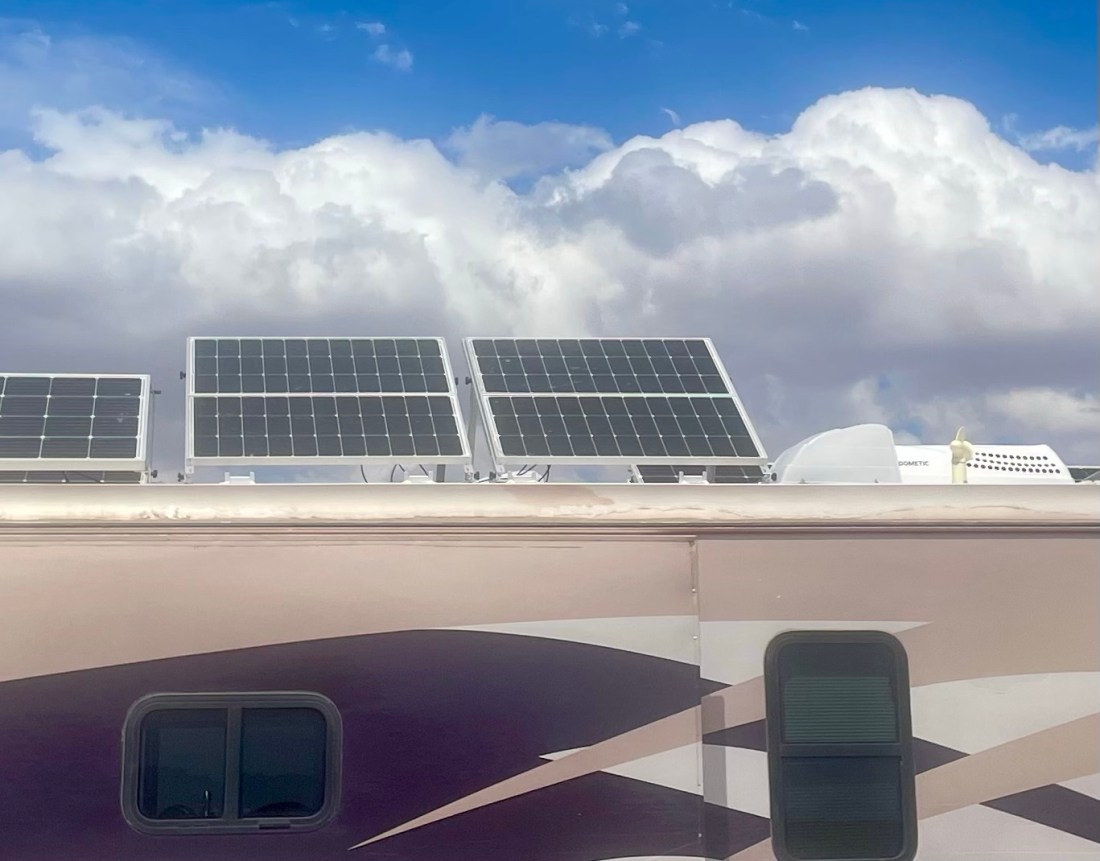
Six panels are tiltable.
Currently, only the two 210-watt panels are tilted.

Recent harvest?

300 amp-hours per day.

And here’s the uncomfortable truth:

We are power hogs.

We like creature comforts.

I don’t want to shut down the inverter overnight.
I don’t want to give up the bed warmer on cold nights.


Peak Solar Hours vs. Daylight Hours

Peak Solar Hours (PSH) are not the same as daylight hours.

On January 6, 2026 in Baja Mexico:

  • 10.5 daylight hours
  • Just over 5 PSH

That means panels only produce at peak output for about half the day.

For comparison, in Woodstock, Ontario the same day:

  • Between 0.5 and 1.5 PSH

Location matters.

A lot.


Tilting Panels — Is It Worth It?

Yes.

Tilting panels can improve harvest by up to 45% in some conditions.

Peak power occurs when the sun hits the panel at a 90° angle — which is constantly changing throughout the day.


Crunching the Numbers

Yesterday’s harvest:

  • 287 amp-hours
  • 3,444 watt-hours (3.44 kWh)

Working backward:

3,444 ÷ 1,540 panel watts = 2.236
2.236 ÷ 3.44 PSH = 65% panel efficiency

I can crunch numbers all day long.

But the bottom line?

We need more panels.

Period.


What’s Next?

We have roof space for:

  • 2 larger panels
  • Possibly 4–6 additional 100-watt panels

That would push us beyond 2,000 watts total array size.

It will require:

  • Additional solar controllers
  • More wiring
  • More expense

But if it means more boondocking freedom?

It’s worth it.

Stay tuned — this upgrade is coming.

On a side note, my original blog was 1900 words long with long rambling paragraphs but, with the help of my AI app it is clear concise and easier to read, if you made it to here how about giving me a like!

Day 3055