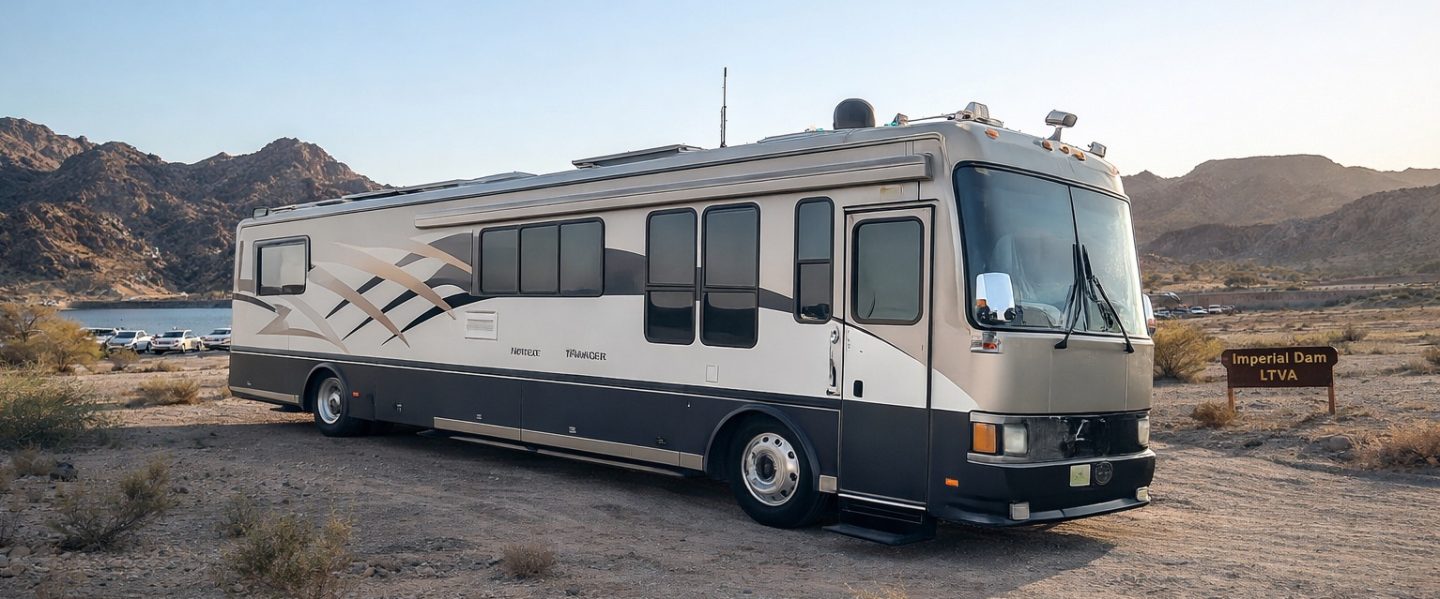


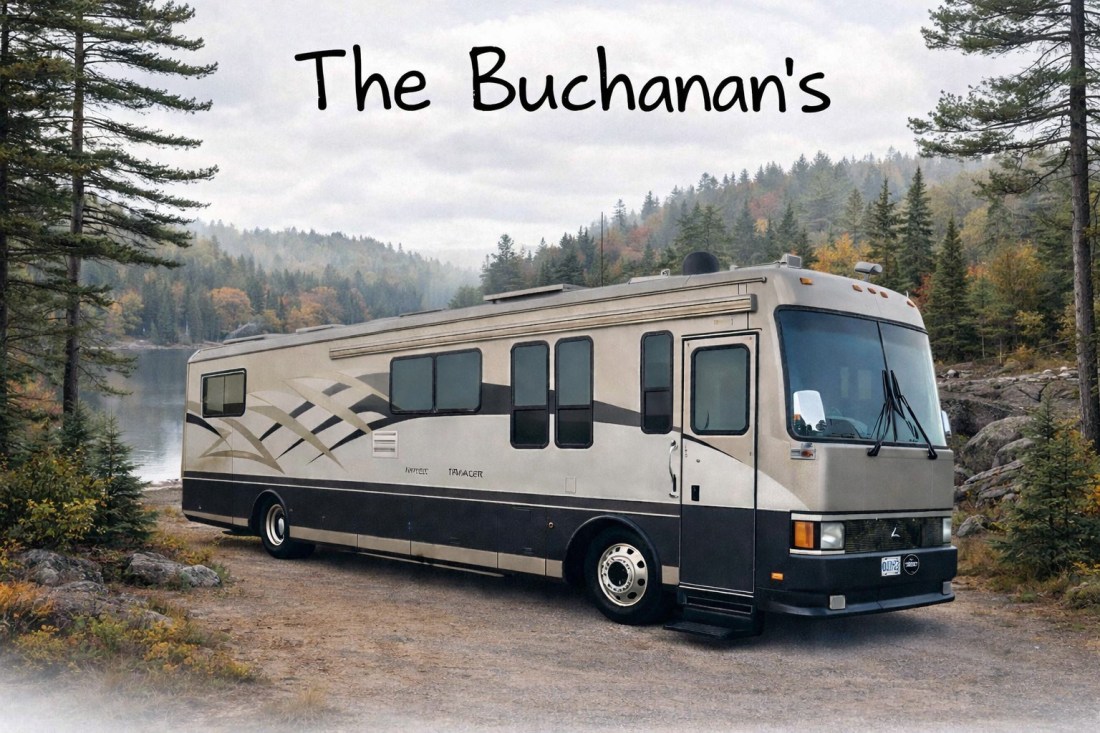
What a great question, it is like they fell off the face of the earth, no new blogs, no posts, just silence … so here is the story.
It will be a long twisting story with lots of entertaining thing now, not so much during the process but it will make for some great fire side tails when we get old…er. I have started to write this a couple of times, and it just keeps getting more twisted because many of the things that we delt with this year have been years in the making so the only place to start is in the beginning and tell the tales that have led to this summer, from here on called the reckoning!
This started way back in 2017 when we purchased Thunder from a RV dealership in Mesa Arizona it happened on the Victoria Day weekend when I flew to Mesa via Calgary and was picked up at the airport by the dealership. I was there to test drive Thunder and check it out and if I liked what I seen I would purchase Thunder and drive back to Ontario, and well that part of the story is smooth enough, so Thunder had to be exported from the United States and Imported into the Canadian system, that consisted of mainly paperwork and a couple of small fees to process the paperwork.
Once imported into Canada Thunder had to be registered in the Province of Ontario, that’s where the payments start so because I still had temporary plates from Arizona, I was able to move Thunder from place to place to accomplish the required work. In Ontario we needed a safety inspection to complete the registration, we had this done at a truck shop in Beamsville and it took very little to pass the safety, and a few hundred dollars later we were able to get Thunder plated in Ontario that was painful as the sales tax portion was substantial but now we were in good shape or so I thought. I knew that the wet bay needed some work as the floor seemed weak from years of water damage, but other that not knowing what I would find I was pretty much ok with the process.
So we purchased Thunder in May, and we had a five week shake down trip planned for July so I was concerned with creature comforts more that anything else, a new mattress, switching out televisions, loading and packing for our trip were the top of the list. And yes I had driven back from Arizona, and I knew that Thunder was what I would call loose on the road I thought it was just a few steering box adjustments and would be simple easy fixes, I have since learned that there are no simple fixes on Thunder. We left in late June and headed to Chicago to the Lions convention, that is where I did my first damage to Thunder pulling out of a tight gate in a parking lot I clipped the right rear fender, there is more to that story but this is not the place, we travelled north from Chicago and spent some time in Wisconsin where we learned a lot about wind and heat as we ended up in Kansas City for a Scentsy convention and then we made our way back to Ontario through St. Louis and Indianapolis. Once homework got in the way off a lot as I was pulled from the sale of our house, selling and packing everything to hit the road, getting Thunder ready, and running our business. So it after we returned that my first endeavour into repairing the coach floor it was obvious that there were a number of water leaks in the wet bay area and this brings up a point that most RV owners would not be aware of on some high-end coaches they uses a water manifold system, this was done to eliminate any water line joints that were not easily accessible, this system has every faucet in the coach fed by one water pipe with no joints other than from the manifold in the wet bay to the kitchen faucet and there is a pipe for every hot and cold so it ends up with a lot of pipes with two to the kitchen, two to the bathroom, two to the shower, two to the washing machine and one to the toilet and one to the pressure washer … yes our coach had a built in pressure washer with to high pressure outlets one on the left front corner and one on the right rear.
This section of floor was small only approximate a meter square, what I learned was that the floor was a laminated unit with some very thin wood products on both sides of an aluminum frame with the space of the frame filled with a Styrofoam product to act as insulation and from the factory everything being glued together made it very strong and durable but water and wood is not a combination that worked well so in its first eighteen years of life no one addressed these small leaks that grew into major issues. The leaks became apparent the first time I hook up to a water connection. So that is the first glance at our water issues.
The first winter as a snow-bird we spent in the south-west states and it was a learning experience in so many ways as I have explained previously but one issue was that Thunder was a wanderer, not a good characteristic for a forty foot long motor coach, it meant that I was constantly adjusting the steering wheel and at highway speeds it does not make for a relaxing drive, and to my chagrin it was not just an adjustment on the steering box. I had not decided it had to be an alignment issue so after our first winter away I took Thunder to a truck alignment shop, this where people take their highway trucks to have solid axles bent to make them go down the road straight and not eat up three-hundred-dollar tires doing so. Thunders front end alignment was good, but they pointed out that there were several bushings that had wear and they suggested they be replaced. So, I asked it they could possibly do the job there and was told no that they did not do that kind of work as they specialized in springs and alignments.
This is the start of a theme, a theme of it is difficult to get good people to work on a motor coach, unlike a highway truck our coach has used every inch of space for construction of a luxury space with as much storage as possible. So now we are driven to people that can and will work on buses and as a technician that used to work on heavy trucks, busses are a whole different ball of wax, but I’m getting older and to be honest I thought I was just too old and weak now to work on this kind of equipment, so I was always looking for good people that would work on our coach. And many shops just said NO, they had no interest in working on busses or motorhomes. And not knowing any local people with coaches it was difficult, the technician that did our safety would do little tasks like oil changes and the like but did not want to tie up valuable shop space on undesirable jobs and as a shop owner he just did not want to do crappy work and things I needed fixed were crappy jobs, even I knew that and most were tasks that I would have avoided as well.
So imagine my delight when I found a truck shop on Vancouver Island that would work on motor-coaches, and the first thing I asked was about the bushings and he said yes, but I needed an oil change, and I had some ride height issues, and he discovered a left rear axle seal leak and that was what he had time to fix the oil seal, change the oil and replace an air valve for the ride height in the two days I was there, amazingly there was never time to get the bushings done. And as annoying as it was, it was never a safety issue the bushings were worn and I’m thinking yea so there is a little play in the wheel and I’ve driven it like this for years so it will be ok till I find a guy.
Well on out trip south last winter we noticed some strange noises but never was able to figure out what and where they were coming from, not unusual it’s a big coach and pinning noises down can be difficult. But I did notice that the front tires were starting to rub on the inner fenders and that’s when I seriously looked at the worn bushings, with our eight air bags suspension the steering axle is held in place by four torque rods, each torque rod has two bushings so if each bushing had an eight of an inch play then with eight that makes an inch of undesirable movement and I think some had more wear than that. So I need to approach this with a little more level of urgency but that will be a summer job back in Ontario or so I told myself.
So jump ahead to December of last year (2025) and we crossed into Mexico for a three month stay in a resort style community, but as soon as we pulled out of the border check point, we could hear a dragging sound (never a good thing) and oh yea did I mention that the rear axle is held in place by torque rods that have bushing as well? Well, a quick check revealed that the right rear torque tube had broken into two pieces and one end was dragging on the pavement, being the handy guy that I am I was able to strap the dragging end up and we continued down the road, we were two and a half hours from our destination. The main issue was the dog-tracking (dog tracking is when the rear wheels don’t follow the front wheels straight) but it is Mexico where nothing is shocking to see on the highway and it is not as if it is a major highway with high speed because of villages and random speed bumps. After we got to our winter site I backed the coach onto blocks to get as much clearance as I could to give as much space as possible for me to work on the torque rod.
To try and condense this adventure let’s just say that I was able to undo the bolts with pipe wrenches and a rachet strap, the process took a couple of days, but I was able to remove the broken torque rod. Hours were spent trying to locate a replacement part and the only option that I was able to find was from Beaver Motorcoach Works in Bend Oregon for only $1595 US + taxes and shipping, and nobody delivers into Mexico so it would have involved a road trip back to the States to a package holding center. The price and the logistics just made in an unlikely option, so many more hours scouring multiple sites I found an alternative it was in a kit form and needed to be welded back together, so I decided to find a local welder and have the two pieces welded together and we would see if we could get home to Ontario.
Another little issue was that the passenger side windshield was cracked and working its way out of position and we had taped it with clear tape because it was throwing shards onto the dash one of Mister Sam’s favorite napping spots again, we are thinking get back to Ontario and get it replaced. Oh, yea when I was under the coach in Mexico I found the cause of the noise on our trek south it was the protective layer of the basement floor peeling off, another back in Ontario job as well as the left rear axle wheel seal is leaking, yea as your thinking another back home job. And if it wasn’t enough crap going on this spring the temperatures in Arizona were driving us to higher elevations in early March.
Now I will try to explain what has made this summer one to forget, we crossed back into Ontario in early May, we spent some time boondocking in parking lots before landing in our fiends driveway in Beamsville. Our campground does not open till the middle of May and there has been so much rain that there will be no way to get into our site. Laurie has landed a couple of job interviews and my job is to get the windshield replaced, I talk to the insurance company and they will pay to replace the glass but they have no recommendation on who or where, I called glass company after glass installer and no one wanted the job, I called RV repair shops and as soon as they heard it was an older coach nobody wanted the job, I knew that the RV shops weren’t doing the glass installs themselves so I just kept calling installers and finally I found one in Fort Erie that would do the job but only if he could replace both windshields, it took a week but he worked it out with the insurance company I paid the $500 deductible and he ordered the glass.
In the meantime, I was trying to locate the parts for the torque rod and I needed to do both rear torque rods but the kit idea made me nervous so once I found a jobber that would order the one kit, I only ordered one kit to confirm it would work. I needed to dump our tanks as we were going on 14 days, so I made a deal with the campground that we would just back onto a no longer used road and wait there till our windshield could be installed and give the ground time to harden up. Well I picked up the first kit and it appeared to be the correct size and I have a welding / fabricating shop that I have used before that I’m going to get to weld this kit together so I had removed the welded piece already so I took both to the fabricating shop and asked them to duplicate what I had, a couple of days later and I had a replacement torque rod in my hand, I just needed to get under the coach and install the new part. Now I sure that you are a little curious as to the cost the kit was $425 Cdn taxes in and a $100 cash to be welded together for a total of $525 Cdn.
I ordered the second torque rod kit for the left rear, and I also ordered a torque multiplier, this precious little piece of Chinese manufacturing reduces the effort required to undo twenty-eight-year-old rusted in place bolts. The problem is that it has a 64 to 1 ratio so while it reduces power needed it increases the number of revolutions required to unthread a rusted nut. In the interim the windshields were delivered and an appointment was made for the installation, and also I should mention that Laurie is now working full time so that my ability to pick up parts has been curtailed somewhat. On the appointment day Laurie left for work and I headed to Fort Erie for an early morning appointment, after my arrival I was directed to the rear of the shop and shortly after the work commenced, changing these windshields are a major job and under the best conditions would take 2 men 5 to 6 hours. And with other appointments coming and going the four man crew worked steadily but it was hot and they were working outside in the heat, so it was close to 4pm when they finished up.
Still parked on the old roadway I had managed to get the second torque rod removed and the new kit fabricated but I was having trouble it get it into position unlike the old worn out bushing the new rod was not very forgiving. The park wants me to pull into the site they feel it is dry enough so with a pinch bar in place of a bolt I repositioned the coach onto our seasonal site for the summer. And the move obviously helped because with a little assistance of a hydraulic jack I was able to get the last bolt in place and the torque rod secured.
My next undertaking was going to be the basement floor, which meant setting up the Clam to use as a storage bin for all of the basement items, this is a major undertaking and although I can not recreate the floor to the factory standards, I can build it back as strong.
The original was a lamination of the aluminum frame, insulation, the protective underside and the thin venire top layer with some carpet, I will use the aluminum frame for major support, I will use a 3/8” fir plywood for the floor surface, I’m having a protective layer of 1/8” puck board, and filling the frame space with 1½” Styrofoam insulation and gluing every layer in the process than I will place peel and stick carpet on top of the plywood surface to prevent thing sliding too much. Demolition and reconstruction took the best part of three weeks having to work around the rain, that had become a almost daily adventure, and of all the steps the installing of the protective coating was the most difficult as I had it made into one huge sheet 15’ long and 5’ wide and because of its characteristics it had to be secured in place with aluminum bar stock and over 100 self drilling screws while laying under the coach. But it is done and I’m pleased I even repositioned out house battery bank under our freshwater tank giving better storage space in the basement, and during this process I added more solar to the roof and another controller in the basement.
Now onto the biggest issue our front torque rods, there are 5 rods all together but I’m just concerned about the main four, with the four front air bags on the front “H” frame which houses the front steering axle and is held in place by the four forty inch long torque rods. I have had a local jobber trying to locate the required parts, the original part number is no longer manufactured and the replacement kit which would be similar to the rear ones the manufacturer has none in stock and it has been marked as no estimated time to be restocked. Now I trying to find other options and with little assistance from my local guys I tracked down a part number for a shorter kit with the same bushing size, there are four in stock in all of North America and they happen to be in Canada so I ordered the four from a jobber in London that went the extra distance to help me secure the parts. Now the kit I needed was for lengths of 30 – 40 inches and the kits I purchased were for 20 – 30 inches. The rods on our coach are forty inches, so with kits in hand I visit the fabricating shop and the shop can source the required materials but they will be expensive, at this point it doesn’t matter I just need them and a quickly as possible.
I maybe made a mistake removing all four rods at once but I wanted the shop to reproduce everything at once if possible and I was not a 100% sure that they were all the same length. So during the week it took to get the material and weld them together the coach shifted on the air bags so as soon as I had the rods I started to reinstall them, it took some brute force with hydraulic jacks but I finally got the first rod in place with punches in the bolt holes and as I pulled and pushed I was able to get bolts into place one at a time and it took the best part of three days to bet all eight bolt in place. And did I mention that I did that in the rain, as it rained for three days I was laying in an inch of water under the coach just mud for head to toe!
And of course, when I pulled the front wheels off to get to the torque rods I noticed that I needed to replace two air bags, and I needed to replace the brake pads, and oh yea the right front axle hub had multiple cracks and needed to be replaced which lead to right front wheel bearings and the front inner fender with all of the damage needed to be replaced as well. I go back to the reality that I have not dealt with the issues as they arose and at 75 years old, I just wasn’t sure if I could take on this many projects all at once, it’s difficult when you have the knowledge but the body just struggles to keep up.
Today is October the first and we have been kicked out of our campsite for the year and we are now mooch-docking in our friends driveway again and I’m still trying to keep stoking items off of my to do list as Laurie is still working till sometime later in October and I still have an ever-growing list.
Just a quick note as a technician by trade I always wanted to take the road-test to confirm any repair and I had not driven Thunder since July the second so when I pulled out of the park on September the 27th and headed to a fuel stop I was more than pleased with the results of my efforts this summer. Our plan in the desert in Arizona for the winter and Laurie and I hope to have a new adventure in the spring back here in Ontario, I can not promise many blogs this month but when we get back on the road, I should be able to get back on track … SEE YOU DOWN THE ROAD
Day 3285