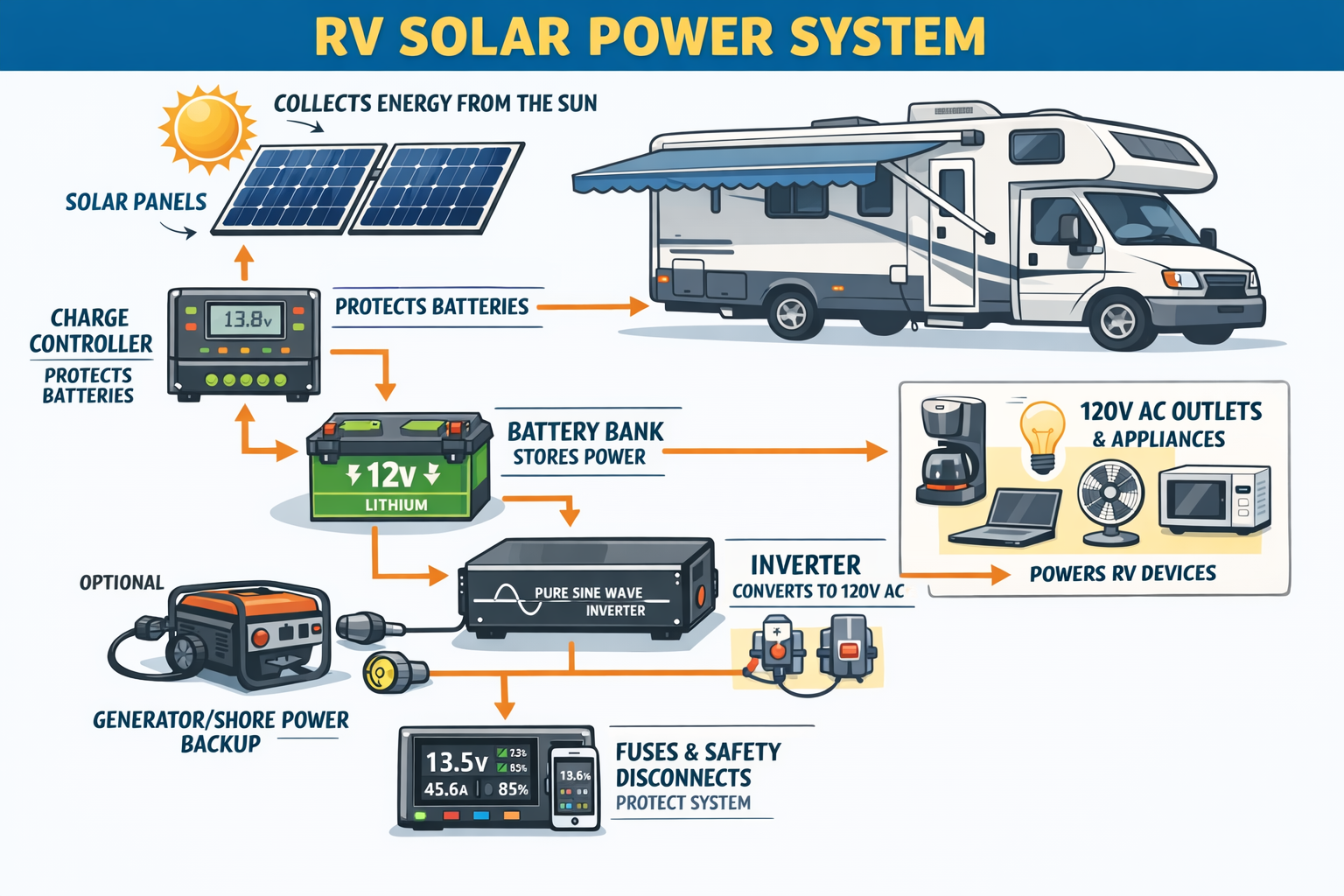


The Rest of RV Solar: Wiring, Protection, Switches, and Safety Components Explained
When people think about RV solar systems, they usually focus on the big-ticket items: solar panels, charge controllers, batteries, and inverters. But the parts that actually connect everything together and keep it safe are just as important.
In many cases, wiring and protection components are what separate a reliable, long-lasting system from one that causes constant problems — or worse, becomes a fire hazard.
This guide covers everything else required for an RV solar system, including:
- Wiring types and sizing
- Fuses, breakers, and disconnects
- Switches and shutoffs
- Connectors and terminals
- 12-volt vs 120-volt protection
- House wire vs marine wire
- Why these components matter
Why “The Small Stuff” Matters in RV Solar
Solar systems move a lot of current, especially on the 12-volt side. Poor wiring or missing protection can cause:
- Voltage drop
- Overheating wires
- Equipment damage
- Fire risk
- Hard-to-diagnose system failures
Think of these components as the plumbing and safety valves of your electrical system.
RV Solar Wiring Basics
DC vs AC Wiring
An RV solar system has two different electrical worlds:
- DC (Direct Current)
Solar panels, charge controller, batteries - AC (Alternating Current)
Inverter output, outlets, appliances
Each requires different wire types and protection.
How to Size Solar Wiring (Beginner Explanation)
Wire size is determined by three factors:
- Current (amps)
- Distance (length of run)
- Voltage
Why Wire Size Matters
- Too small → heat buildup & voltage loss
- Proper size → efficient, cool, safe operation
Key Rule of Thumb
Lower voltage systems require thicker wire
This is why battery and inverter cables are so large compared to household wiring.
Typical RV Solar Wire Sizes
| Application | Common Wire Size |
|---|---|
| Panel to controller | 10–8 AWG |
| Controller to batteries | 6–2 AWG |
| Battery interconnects | 4–2/0 AWG |
| Inverter cables | 2/0–4/0 AWG |
| AC outlets | 12–14 AWG |
(Exact sizing depends on distance and current.)
House Wire vs Marine Wire: What’s the Difference?
House Wire (Solid or Romex)
- Solid copper
- Designed for buildings
- Not vibration resistant
- Not moisture resistant
Marine / RV Wire (Stranded)
- Finely stranded copper
- Flexible
- Vibration resistant
- Tinned copper resists corrosion
- Rated for damp environments
RV Solar Rule
Always use stranded marine-grade wire for DC systems
Solid wire can crack and fail over time in a moving vehicle.
Types of Required Switches & Disconnects
Battery Disconnect Switch
- Allows complete shutdown of DC system
- Required for safety and maintenance
- Must be rated for full system current
Solar Disconnect
- Isolates panels from charge controller
- Required by electrical codes
- Prevents accidental live wiring
Inverter Disconnect
- Allows safe inverter servicing
- Prevents arc flash during maintenance
Disconnects should be:
- Clearly labeled
- Easily accessible
- Rated for DC use (important!)
Fuses vs Breakers: What’s the Difference?
Fuses
- One-time protection
- Must be replaced after blowing
- Very fast acting
- Simple and reliable
Breakers
- Resettable
- Can act as a switch
- Slightly slower response
- Convenient for maintenance
Both are used in RV solar systems.
Common Fuse Types in RV Solar
ANL Fuses
- High-current DC protection
- Used near batteries and inverters
MIDI / MEGA Fuses
- Compact high-current fuses
- Common in battery and controller circuits
Inline Fuses
- Smaller circuits
- Electronics protection
Circuit Breakers in RV Solar
DC Breakers
- Designed to interrupt DC arcs
- Must be DC-rated
- Used between components
AC Breakers
- Same style as household breakers
- Used after inverter
- Protect outlets and appliances
⚠ AC breakers cannot safely interrupt DC current
12-Volt vs 120-Volt Breakers
| Feature | 12V DC Breaker | 120V AC Breaker |
|---|---|---|
| Current Flow | One direction | Alternating |
| Arc Control | Difficult | Easier |
| Design | Specialized | Standard |
| Interchangeable? | ❌ No | ❌ No |
Using the wrong breaker is a serious safety hazard.
Required Grounding & Bonding
DC Grounding
- Battery negative bonded to chassis
- Prevents floating voltages
AC Grounding
- Inverter ground bonded to RV frame
- Neutral-ground bonding depends on inverter design
Proper grounding:
- Reduces shock risk
- Improves inverter stability
- Required by code
Connectors & Terminals
Common Connector Types
- MC4 connectors – solar panels
- Ring terminals – battery & bus bars
- Lugs – inverter cables
- Bus bars – clean power distribution
Best Practices
- Use crimped (not soldered) DC lugs
- Use heat-shrink terminals
- Torque connections properly
- Re-check annually
Bus Bars: The Hidden Upgrade
Bus bars allow:
- Cleaner wiring
- Easier expansion
- Even current distribution
- Reduced stress on battery terminals
They are highly recommended for medium and large RV solar systems.
Cable Management & Protection
- Use grommets through metal
- Protect wires from sharp edges
- Secure cables against vibration
- Separate DC and AC wiring
- Label everything
Good cable management is not cosmetic — it’s safety.
Monitoring & Shunts (Often Overlooked)
Battery monitors use a shunt to measure current flow.
Benefits:
- Accurate state of charge
- Real-time usage data
- Prevents accidental over-discharge
A battery monitor is one of the most valuable solar accessories.
Everything Else Checklist (Beyond Major Components)
✔ Wiring (correct size & type)
✔ Fuses and fuse holders
✔ DC and AC breakers
✔ Disconnect switches
✔ Bus bars
✔ Grounding hardware
✔ Cable glands & grommets
✔ Connectors & terminals
✔ Battery monitor & shunt
✔ Labels and documentation
Final Thoughts: Solar Systems Are Built on Details
Solar panels make power, but wiring and protection determine whether that power is delivered safely and reliably. Many RV solar failures are not caused by panels or batteries — they’re caused by undersized wire, missing fuses, or improper breakers.
A well-built solar system is:
- Efficient
- Serviceable
- Expandable
- Safe
And most importantly:
Boring when it’s working — and that’s exactly what you want.
Day 3117
Discover more from The Buchanan's Rolling Down The Road
Subscribe to get the latest posts sent to your email.

