

Another Canadian fall was upon us, which meant it was once again time to point Thunder south and west and go looking for someplace where November doesn’t require a snow shovel.
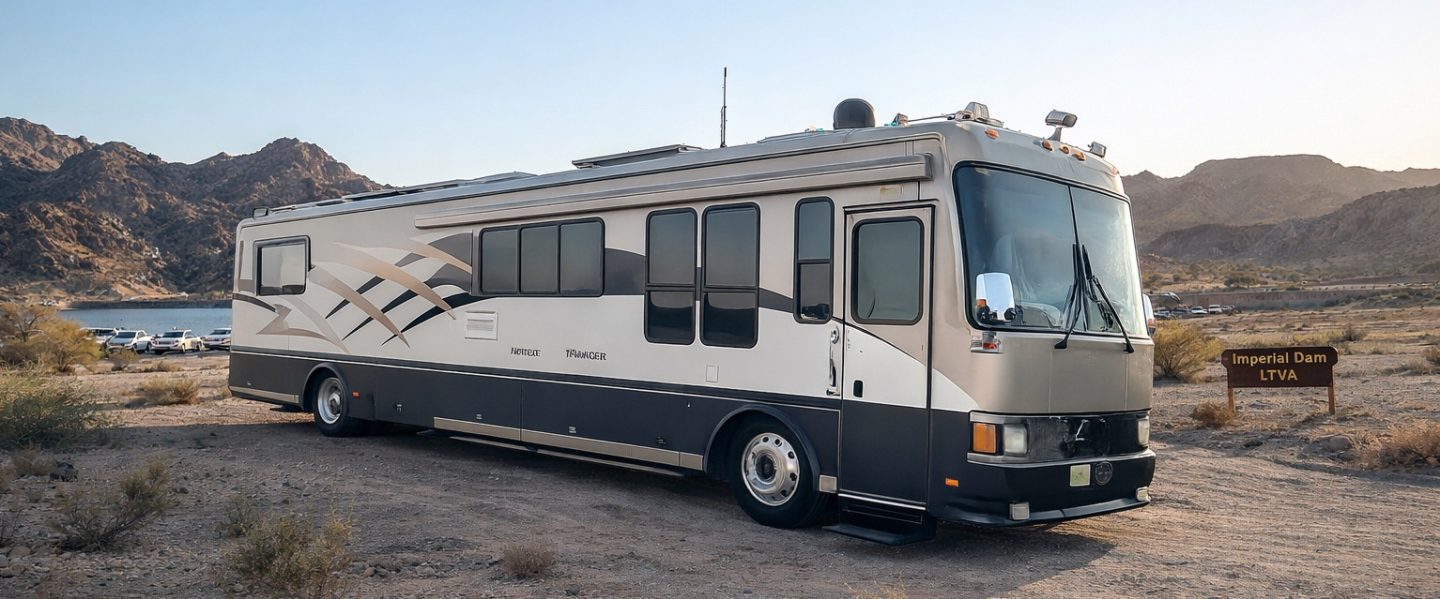
Our destination was Imperial Dam LTVA, on the California-Arizona border, where sunshine, warm temperatures and several months of desert boondocking awaited us.
Our original plan was to leave Ontario on November 2.
We left on November 3.
Which, by RV standards, means we were pretty much exactly on schedule.
November 3: Ontario to Bowling Green, Ohio, 301 Miles
We started the trip with a fairly ambitious 301-mile day, making up our delayed departure in one shot and reaching our familiar Walmart stop in Bowling Green, Ohio.
Bowling Green is a regular stop for us because it puts us less than half an hour from our very dear friends near Pemberville. It was one of the important stops in the plan right from the beginning.
For once, Thunder behaved itself and we arrived with nothing more dramatic than 301 miles added to the odometer.
Perhaps that should have made me suspicious.
November 4: Bowling Green, Ohio, Visit Day, 0 Miles
Wednesday was deliberately a no-travel day.
The Beaver stayed parked while we spent the day visiting our friends, so our grand contribution to the trip mileage was exactly zero miles.
Ruby, however, apparently didn’t understand the concept of a day off.
I discovered a broken shifter bushing was preventing the Jeep’s transfer case from engaging, which is somewhat inconvenient when the Jeep is supposed to spend the next few thousand miles following obediently behind the motorhome.
Fortunately, this turned out to be one of those rare vehicle repairs where the number on the receipt didn’t require sitting down first.
A new bushing cost $12.95 US, and I was able to get Ruby back in business right there in the Walmart parking lot.
Problem solved.
Surely that would be our mechanical problem for the trip.
Right?
November 5: Bowling Green to Florence, Kentucky, 190 Miles
Thursday morning we headed south again, bound for Florence, Kentucky, with a relatively easy 190-mile day ahead of us.
Apparently Thunder had watched Ruby getting all that attention the day before and felt left out.
While travelling south on I-75 near Findlay, Ohio, we developed a coolant leak from the lower radiator hose.
There are many fine places in Ohio to spend part of an afternoon.
The shoulder of I-75 isn’t particularly high on my list.
The repair cost $174 US, considerably more than Ruby’s $12.95 contribution to the adventure, but the important part was that we got it fixed, got back on the road and didn’t lose a travel day.
By the end of the day we had made it to the Florence area as planned.
So, three days into our cross-country adventure, both vehicles had already required repairs.
Fortunately, both were relatively minor.
More importantly, I was beginning to hope the third member of this travelling circus wouldn’t be me.
November 6: Florence to White House, Tennessee, 238 Miles
Friday was a much less exciting 238 miles, taking us south to White House, Tennessee, where Walmart provided our accommodations for the evening.
Five-star resort?
Perhaps not.
But I’ve yet to find a five-star resort willing to accommodate a 40-foot diesel pusher, a Jeep and our own bedroom for the same price.
November 7: White House to West Memphis, Arkansas, 241 Miles
Saturday we put another 241 miles behind us as we made our way across Tennessee and into West Memphis, Arkansas, where the casino became home for the night.
By now we had settled into the familiar rhythm of one of our cross-country migrations.
Drive.
Park.
Check everything.
Figure out tomorrow.
Sleep.
Repeat.
November 8: West Memphis to New Boston, Texas, 290 Miles
Sunday was another fairly substantial travel day.
We covered 290 miles from West Memphis to New Boston, Texas, settling into the Walmart there for the night.
We had officially arrived in Texas.
The good news was that we were making excellent progress west.
The bad news was that Texas apparently goes on forever.
November 9: New Boston to Eastland, Texas, 280 Miles
Monday brought another 280 miles, taking us through the Dallas-Fort Worth area and eventually into Eastland, Texas, where another Walmart became home for the night.
At this point we had driven 570 miles since leaving West Memphis.
We were still in Texas.
Of course we were.
November 10: Eastland to Wickett, Texas, 269 Miles
Tuesday added another 269 miles, bringing us to Wickett City Park.
This wasn’t simply somewhere to sleep. It gave us an opportunity to take care of some of the glamorous realities of travelling with your house.
We had hookups, got the second load of laundry finished, took care of the tanks, added some water to our freshwater supply and topped up the batteries before continuing west.
Nothing quite says cross-country adventure like discussing whether the second load of laundry is finished yet.
Still, things were clean, tanks had been attended to, batteries were happy and, perhaps most importantly, we were getting very close to the western edge of Texas.
November 11: Wickett to Las Cruces, New Mexico, 285 Miles
Wednesday was another good driving day at 285 miles.
And finally…
New Mexico.
We had escaped Texas.
We made our way into Las Cruces, where a Cracker Barrel provided our overnight parking.
It’s not that I have anything against Texas. It’s just that after several days of driving across it, you begin to wonder if somebody is quietly moving the western state line while you’re driving.
November 12: Las Cruces to Tucson, Arizona, 278 Miles
Thursday morning we climbed back onto I-10 and pointed Thunder west for another 278 miles.
By the end of the day we’d reached Desert Diamond Casino in Tucson.
Now the landscape really looked and felt like the Southwest, and more importantly, there was only one driving day left.
The next time we shut down that big Caterpillar, we’d be at Imperial Dam.
November 13: Tucson to Imperial Dam, 272 Miles
Friday morning we rolled away from Tucson and headed west for the final 272 miles.
And our first day driving in some rain, all the way to Arizona to find some rain!
At approximately 2:00 PM, we pulled into Imperial Dam LTVA.
Engine off.
Parking brake on.
We had made it.
Our recorded daily mileage for the trip totaled 2,644 miles.
Interestingly, Thunder’s trip computer provides a pretty good cross-check on that number. It recorded 308 gallons of fuel consumed while averaging 8.6 MPG. Multiplying those two figures gives 2,648.8 miles, a difference of less than five miles from our daily total.
Considering we’re dealing with rounded numbers from two different ways of keeping track, I’d call that close enough for government work.
And Then There Was the Fuel Bill…
There was another story unfolding during this trip.
Diesel.
Or, more specifically, the alarming amount of money being exchanged every time I pulled into a truck stop and fed that Caterpillar.
This was easily the most expensive of our many trips across the country when it came to fuel.
And this year there was a rather large elephant in the room.
The 2026 conflict with Iran had a major impact on petroleum markets and diesel prices. Disruptions to oil supplies and shipping through the Strait of Hormuz helped push diesel prices substantially higher around the world.
From my perspective, that made the bill particularly frustrating because this was a conflict of choice by the present administration, with ordinary travelers, truckers and businesses among those seeing the consequences every time they pulled up to a diesel pump.
Whatever one’s politics, we certainly felt the cost of high diesel prices firsthand.
And we were crossing the continent with a Caterpillar C12.
Excellent timing on our part.
308 Gallons Later…
According to Thunder’s trip computer, we burned 308 U.S. gallons of diesel getting ourselves and our home across the country.
When I went back through the expenses after arriving at Imperial Dam, I came up with a total fuel cost of:
$2,707.93 Canadian.
Ouch.
There is, however, another side to that number.
According to the coach trip computer, over the entire trip we averaged:
8.6 MPG
For our Canadian readers, that works out to approximately:
27.4 litres per 100 kilometres.
Now, 27.4 L/100 km isn’t going to have Toyota Prius owners lining up to congratulate me.
But let’s put things into perspective.
This is a 40-foot diesel pusher powered by a Caterpillar C12, loaded with everything we need to live for months at a time, while towing Ruby four-down behind us.
And we’re getting 8.6 MPG doing it.
I’ll take it.
Our fuel discount programs also did their part to reduce the pain. Over the course of the trip we received $188.98 US in fuel discounts.
Our cheapest diesel was in Texas, working out to approximately $1.99 Canadian per liter.
When two bucks a liter starts looking like a bargain, you know you’ve picked an interesting year for a cross-country road trip.
The Surprisingly Cheap Part of the Adventure
If the fuel companies did particularly well from our migration south this year, the campground industry certainly didn’t.
Our total camping expense for the entire trip was $23.04 Canadian.
Yep.
$23.04.
We spent another $10 for a septic dump in Ontario, plus we bought two Cracker Barrel breakfasts along the way.
Now, whether two Cracker Barrel breakfasts should properly be considered camping expenses is open to debate.
Personally, I consider bacon an essential RV consumable.
Between Walmart parking lots, the casino, our Cracker Barrel overnight and inexpensive stops such as Wickett City Park, we managed to cross most of a continent for less in camping fees than some RV parks charge for a single night.
That’s boondocking.
And it’s a pretty good example of why we enjoy travelling this way.
The Trip at a Glance
- November 3: Ontario to Bowling Green, Ohio – 301 miles
- November 4: Bowling Green visit day – 0 miles
- November 5: Bowling Green to Florence, Kentucky – 190 miles
- November 6: Florence to White House, Tennessee – 238 miles
- November 7: White House to West Memphis, Arkansas – 241 miles
- November 8: West Memphis to New Boston, Texas – 290 miles
- November 9: New Boston to Eastland, Texas – 280 miles
- November 10: Eastland to Wickett, Texas – 269 miles
- November 11: Wickett to Las Cruces, New Mexico – 285 miles
- November 12: Las Cruces to Tucson, Arizona – 278 miles
- November 13: Tucson to Imperial Dam LTVA – 272 miles
Total recorded mileage: 2,644 miles
So, What Did It Actually Take?
By the time we shut Thunder down at Imperial Dam, the final score looked something like this:
Total recorded mileage: 2,644 miles
Trip-computer calculated distance: approximately 2,649 miles
Diesel consumed: 308 U.S. gallons
Average fuel economy: 8.6 MPG / 27.4 L/100 km
Total fuel expense: $2,707.93 Canadian
Fuel discounts: $188.98 US
Cheapest diesel: approximately $1.99 Canadian per liter in Texas
Total camping expense: $23.04 Canadian
Ontario septic dump: $10
Ruby’s shifter-bushing repair: $12.95 US
Thunder’s lower radiator-hose repair: $174 US
Cracker Barrel breakfasts: Two
Mechanical repairs: Two
Travel days lost to mechanical failures: Zero
Arrival at Imperial Dam: November 13 at approximately 2:00 PM
Was It Worth It?
So yes, this was our most expensive cross-country trip when it came to fuel.
Ruby broke a shifter bushing before we really got started.
Thunder followed that up the next day with a leaking lower radiator hose on I-75.
Diesel prices were high enough to make a grown man whimper while inserting his credit card.
We travelled 2,644 miles and burned 308 gallons of diesel doing it.
And somehow we spent only $23.04 on camping.
Somewhere in there, I figure it all balances out.
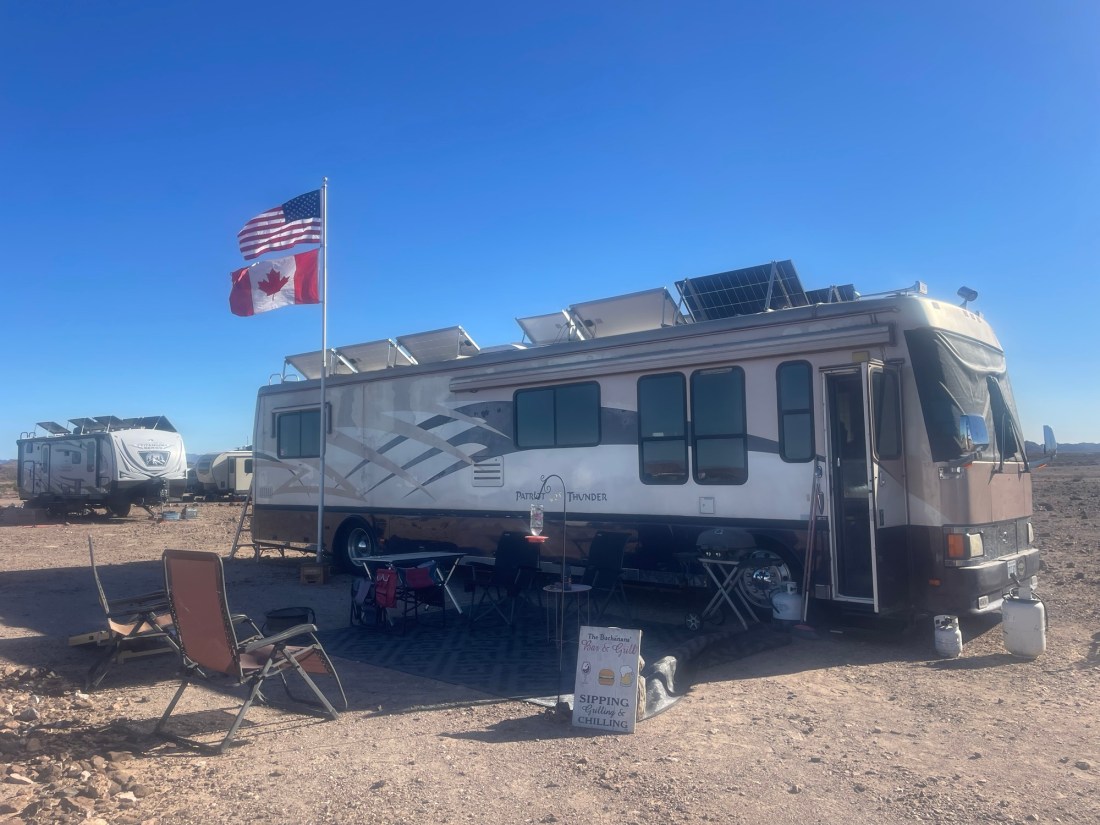
Besides, by two o’clock Friday afternoon, Thunder was parked at Imperial Dam, the Caterpillar was finally quiet, the desert was outside our door and we had months of sunshine ahead of us for only $180 U.S. till April.
Was it worth it?
Absolutely.
Although after $2,707.93 worth of diesel, I think we’ll sit here for a while.
Day 3335