Stage 2: Real‑World Performance, System Refinements, and the Payoff of Doing It Right


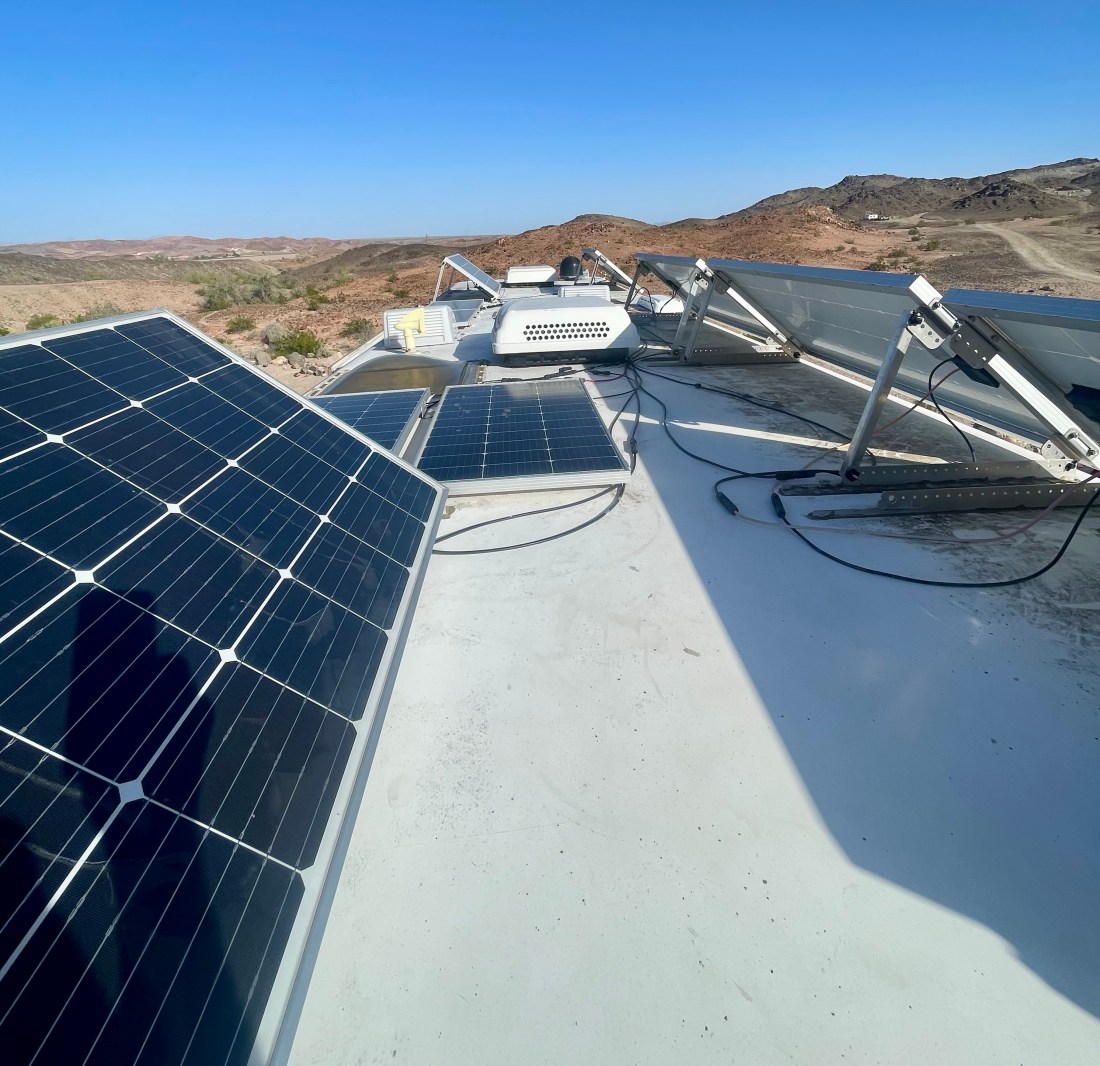
After weeks of wiring changes, controller upgrades, tilt adjustments, and chasing shadows across the roof, the solar system finally delivered the kind of performance the theory always promised. Mid‑February in Winterhaven, CA isn’t supposed to be peak solar season, yet the last two days produced 7,250 watt‑hours and 7,513 watt‑hours, with the batteries topping off by afternoon. These numbers confirm that the system is now operating close to its true 1,540‑watt potential.

Matching the Theory With Real‑World Results
The array consists of:

  • 2 × 210‑watt panels (420 W)
  • 4 × 180‑watt panels (720 W)
  • 4 × 100‑watt panels (400 W)

Totaling 1,540 watts, the theoretical February harvest in Winterhaven—using roughly 5.5 peak sun hours—lands around 8.47 kWh. Hitting 7.2–7.5 kWh in real conditions puts the system at 85–89% of theoretical output, which is exceptional for winter sun, real‑world temperatures, wiring losses, and the inevitable shading challenges of an RV roof.
These numbers aren’t guesses or projections—they’re the result of actual harvest data over multiple days, and they validate the design decisions made along the way.

The Fourth Controller: The Turning Point


The biggest leap in performance came from adding a fourth solar controller. This upgrade allowed each array to operate independently, eliminating the compromises that come from mixing panel sizes, voltages, and shading profiles on shared controllers.
With the new layout:

  • The 210‑watt pair now runs in full series on the Victron MPPT 100/30, reaching clean high‑voltage operation and pulling peaks up to 2.1 kW.
  • The 4 × 180‑watt array runs as a matched series string on its Blue Sky controller, exactly as designed.
  • The 4 × 100‑watt panels were moved to their own controller, freeing them to be rewired for shading tolerance without affecting the rest of the system.
    This separation eliminated the clipping that previously held the system back. Each controller now tracks its own array without interference, and the results show it.

Before and After: A System Transformed

Before

  • Mixed arrays sharing controllers
  • Voltage mismatches causing early clipping
  • Shading on the 100‑watt panels dragging down entire strings
  • Tilt set “by eye,” leaving watts on the table
  • Roof real estate feeling like a puzzle with no clean solution

After

  • Four independent MPPT controllers
  • All major arrays running in clean series strings
  • The 100‑watt array rewired in parallel to isolate shading
  • Tilt optimized using the app for maximum winter performance
  • Batteries topping off in mid‑February
  • Daily harvests consistently above 7 kWh

The transformation is visible not just in the numbers, but in how predictably the system now behaves. The theory said this configuration should work—and the real‑world data now confirms it.

One of the ongoing issues was the potential for a voltage drop issue, I know it is not a serious issue but it is still an issue. All controllers were removed and reinstalled to shorten all of the wiring. Now all PV cables from the roof are 10 gauge solar wire, each solar feed has a 40 amp circuit breaker (as protection and a way to control the circuit) each battery power line has been upgraded to 6 gauge wire with new crimped cable ends to a 50 amp fuse and then to a bus bar that combines all the power and ground lines into 00 gauge wire to the battery on both positive and negative lines. the 00 gauge wires are my longest wires, so I’m thinking the voltage drop issue should be resolved.


What’s Left for Stage 3
The system is now functionally complete and performing at a level that matches its design. The remaining tasks are refinements:

  • Making the 4 × 100‑watt array tippable
  • Eliminating the last sources of morning and afternoon shading
  • Returning the 100‑watt array to a series/parallel configuration once shading is resolved
  • Finalizing roof placement now that performance data is guiding the decisions

These aren’t fixes—they’re optimizations aimed at squeezing out the last few percent of performance.


Day 3076
Solar – Controller -101

RV Solar Charge Controllers Explained: How They Work, Types, and the Pros & Cons of Each

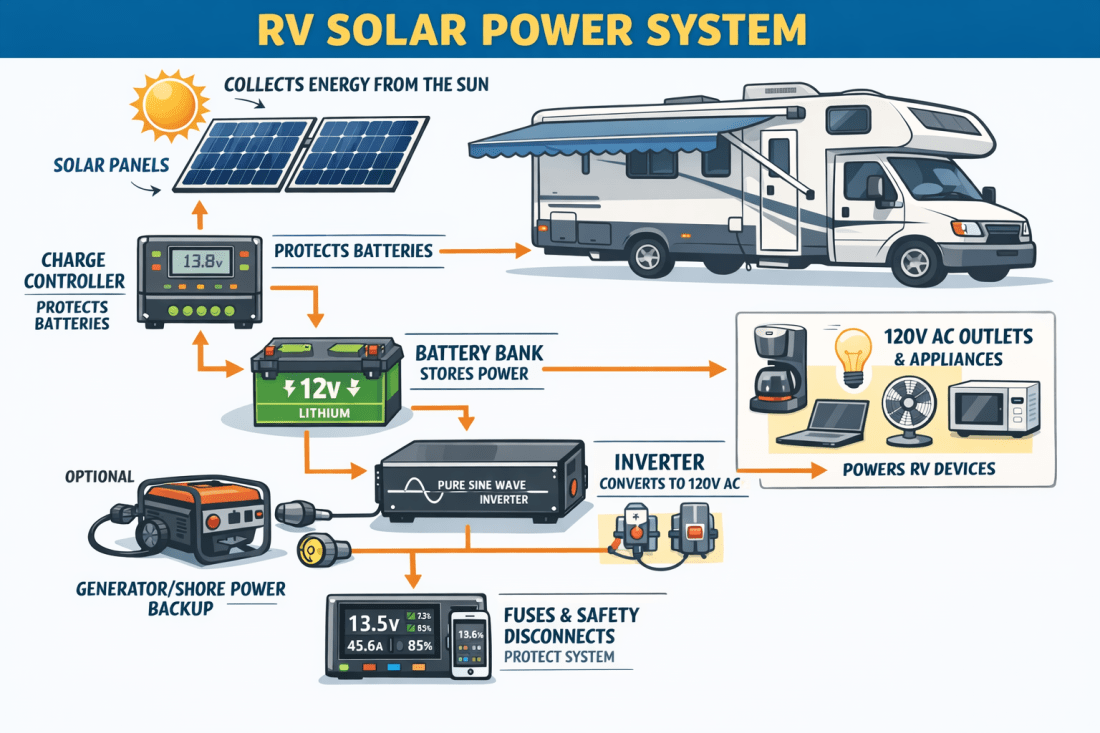
A solar charge controller is one of the most important — and most misunderstood — components in an RV solar system. While solar panels generate power and batteries store it, the charge controller acts as the brain and safety gatekeeper between them.

Without a proper charge controller, batteries can be damaged, solar panels can be wasted, and system efficiency can drop dramatically.

This article explains:

  • What a solar charge controller does
  • How it operates in real RV conditions
  • The two main types of charge controllers
  • The advantages and disadvantages of each
  • How to choose the right controller for your RV

What Is a Solar Charge Controller?

A solar charge controller regulates the voltage and current coming from your solar panels before it reaches your batteries.

In Simple Terms:

  • Solar panels can produce more voltage than batteries can safely accept
  • The charge controller reduces and manages that power
  • It prevents overcharging, overheating, and battery damage

Think of a charge controller as:

A smart valve that fills the batteries safely and efficiently


How a RV Solar Charge Controller Works

Step-by-Step Operation

  1. Receives power from the solar panels
  2. Adjusts voltage and current to match battery needs
  3. Controls charging stages
  4. Stops charging when batteries are full
  5. Restarts charging when batteries need it

Typical Charging Stages

  1. Bulk Stage
    • Maximum power sent to batteries
    • Fast charging
  2. Absorption Stage
    • Voltage held steady
    • Batteries fill slowly and safely
  3. Float Stage
    • Maintains full charge
    • Prevents overcharging

(Some systems include an equalization stage for lead-acid batteries.)


Why Charge Controllers Are Critical in RV Systems

RV solar systems experience:

  • Changing sunlight conditions
  • Temperature swings
  • Partial shading
  • Varying battery loads

A charge controller constantly adjusts to these conditions to protect your batteries and maximize solar harvest.


The Two Main Types of RV Solar Charge Controllers

There are two primary types used in RV systems:

  1. PWM (Pulse Width Modulation)
  2. MPPT (Maximum Power Point Tracking)

1. PWM Charge Controllers

What Is PWM?

PWM controllers reduce panel voltage to battery voltage by rapidly switching the connection on and off.

How PWM Works (Simplified)

  • Panel voltage is pulled down to match battery voltage
  • Excess voltage is essentially discarded
  • Current remains mostly unchanged

Advantages of PWM Controllers

  • Lower cost
  • Simple design
  • Reliable and proven technology
  • Works well with small systems
  • Minimal electrical noise

Disadvantages of PWM Controllers

  • Lower efficiency
  • Wasted panel voltage
  • Poor performance in cold weather
  • Not ideal for larger arrays
  • Requires panel voltage to match battery voltage

Best Use Case for PWM

  • Small RV solar systems (under ~200W)
  • Short cable runs
  • Budget-conscious builds
  • Warm climates with flat-mounted panels

2. MPPT Charge Controllers

What Is MPPT?

MPPT controllers actively track the optimal voltage and current from the solar panels and convert excess voltage into usable charging current.

How MPPT Works (Simplified)

  • Panels operate at their most efficient voltage
  • Controller converts extra voltage into more amps
  • Batteries receive more total energy

Advantages of MPPT Controllers

  • 15–30% more efficient than PWM
  • Excellent in cold weather
  • Handles higher panel voltages
  • Allows longer cable runs
  • Maximizes power in low-light conditions

Disadvantages of MPPT Controllers

  • Higher upfront cost
  • More complex electronics
  • Slightly more setup required

Best Use Case for MPPT

  • Medium to large RV solar systems
  • Winter RVing
  • Northern latitudes
  • Lithium battery systems
  • Roofs with limited space

PWM vs MPPT: Quick Comparison

FeaturePWMMPPT
EfficiencyLowerHigher
CostLowerHigher
Cold Weather PerformancePoorExcellent
Panel Voltage FlexibilityLowHigh
Cable Run LengthShortLong
System SizeSmallMedium–Large

Battery Type Compatibility

Lead-Acid Batteries

  • Work with both PWM and MPPT
  • Benefit moderately from MPPT
  • Require temperature compensation

Lithium Batteries (LiFePO₄)

  • Strongly benefit from MPPT
  • Require precise voltage control
  • Often include battery communication (BMS)

Real-World RV Scenarios

Weekend or Summer RVers

  • PWM may be sufficient
  • Simpler and cheaper

Full-Time RVers

  • MPPT strongly recommended
  • Better efficiency and flexibility

Winter or Northern Latitude RVers

  • MPPT is almost essential
  • Lower sun angles benefit greatly from voltage conversion

Common Charge Controller Features to Look For

  • Battery temperature sensor
  • Programmable battery profiles
  • Bluetooth or display monitoring
  • Load output terminals
  • Expandability for future panels

Common Mistakes RVers Make

  • Undersizing the charge controller
  • Using PWM with high-voltage panels
  • Ignoring battery temperature limits
  • Mounting controller too far from batteries
  • Failing to monitor charging behavior

Final Thoughts: Choosing the Right Charge Controller

The charge controller may not be the most visible part of your RV solar system, but it plays one of the most critical roles. Choosing the right controller protects your batteries, improves efficiency, and ensures your system performs reliably across seasons and locations.

For most modern RV solar systems:

MPPT charge controllers offer the best long-term value, flexibility, and performance.


Day 3060