Why Our RV Solar System Was Falling Behind

Part 1

Why My 1540‑Watt RV Solar System Was Underperforming — and How Data Proved It

For a long time, my RV solar system lived in an uncomfortable gray area.

It worked.
The batteries stayed charged most of the time.
Nothing was obviously broken.

And yet… something didn’t feel right.

On paper, I had 1540 watts of solar, lithium batteries, and MPPT charge controllers — a setup that should have been more than adequate for my needs. But real‑world results didn’t always line up with expectations.

Instead of immediately buying more panels, I decided to step back and answer one question honestly:

Was my system actually too small — or was I quietly wasting energy?

This post documents the starting point, the measurements that raised red flags, and the reasoning that led to a data‑driven redesign.


The Original System (Before Any Changes)

Here’s what I started with:

  • Solar array: 1540 watts total
  • Battery bank: 600 Ah Battle Born lithium (12 V)
  • Charge controllers:
    • 3 × Blue Sky SB3024iL MPPT controllers
  • Wiring:
    • Roof PV runs: 10 AWG
    • Controller‑to‑battery: 8 AWG
  • Panel mix:
    • 4 × 100 W
    • 4 × 180 W
    • 2 × 210 W
  • Mounting:
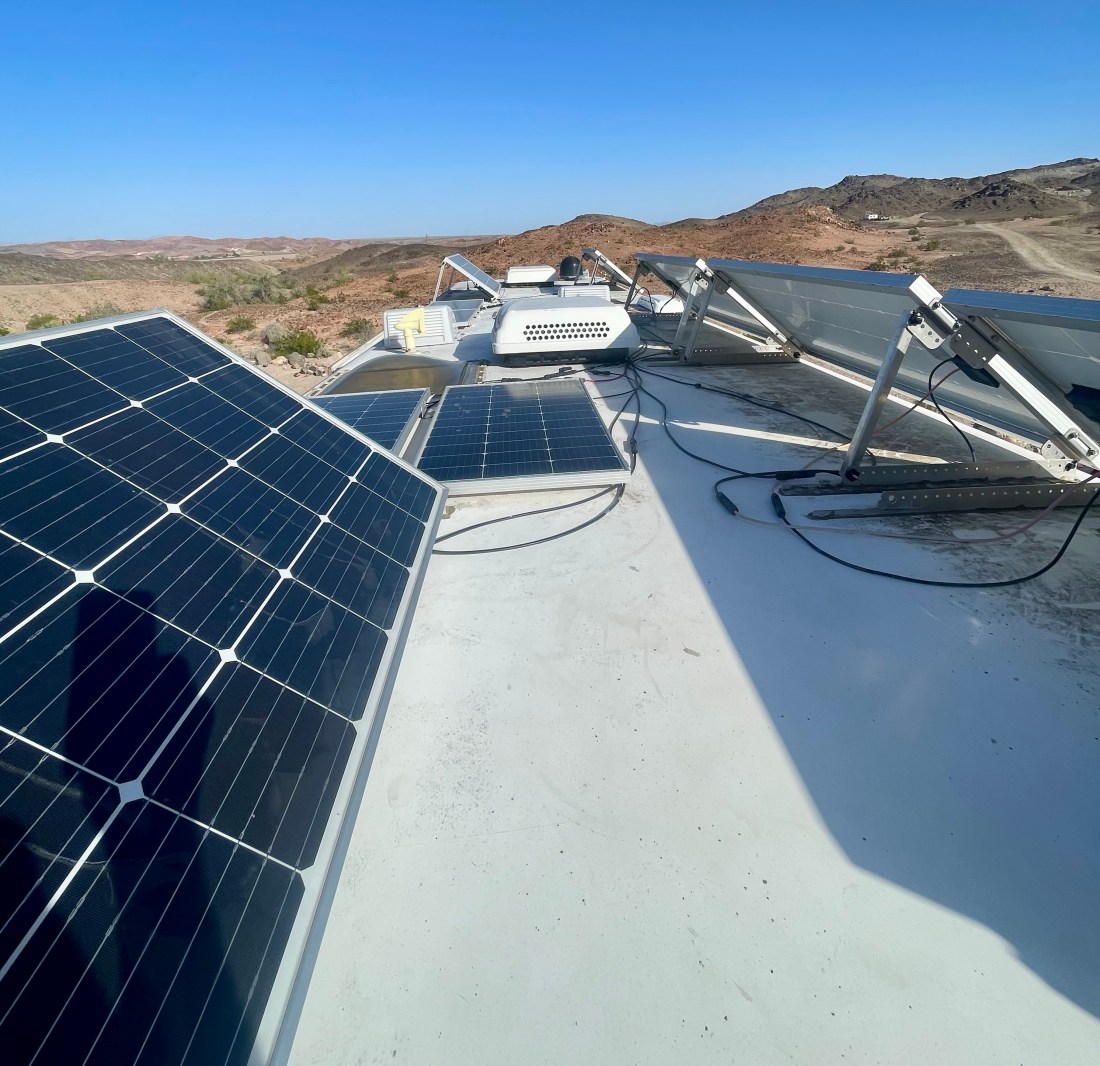
    • All panels flat on the roof

Nothing here is exotic. In fact, this is a fairly typical “well‑equipped” RV solar system.


Callout: Why this matters
Many RV solar systems “work” while still leaving significant energy on the roof. Without measurement, it’s almost impossible to tell the difference between adequate and efficient.


The Data Point That Started Everything

On a clear winter day in San Felipe, Baja California, I measured my actual solar harvest:

  • 398 amp‑hours into the battery bank

At lithium charging voltages, that works out to roughly:

  • 5.5–5.7 kWh delivered

That number wasn’t terrible — but given the array size, location, and clear conditions, it felt low enough to justify investigation.


Callout: Important context
With lithium batteries, aggressive charge tapering is usually not the limiting factor unless the bank is nearly full. With 600 Ah available, battery acceptance was not the obvious bottleneck.


The Wrong First Instinct: “Just Add More Panels”

The most common reaction to underperforming solar is simple:

“I need more panels.”

That approach is sometimes correct — but it’s also how people end up with larger, more expensive systems that are still inefficient.

Before adding capacity, I wanted to understand whether my existing watts were being used effectively.

That meant looking upstream of the batteries.


The First Hidden Issue: Mixed Panels on Single MPPT Controllers

An MPPT controller can only do one thing at a time:

Track one electrical operating point.

In my original configuration, multiple controllers were connected to mixed panel types — different wattages, different voltage/current characteristics, all feeding a single MPPT input.

Nothing was “wrong” in the sense of errors or failures.
But electrically, the MPPT was forced into a compromise that was optimal for none of the panels.

This kind of loss is:

  • Silent
  • Continuous
  • Easy to miss

And it adds up every single day.


Callout: MPPT reality check
MPPT controllers are powerful, but they are not magic. One tracker cannot independently optimize multiple dissimilar panel groups.


The Second Hidden Issue: Low PV Voltage, High PV Current

Most of my array was effectively operating at 12‑volt PV levels.

That has consequences:

  • Higher current on the roof
  • Higher I²R losses in the wiring
  • More voltage drop before power even reaches the controller

Even with decent wire gauge, current is the enemy of efficiency in low‑voltage DC systems.


Diagram 1: Original System Architecture (Conceptual)

Roof Panels (mixed) ──┐
├── Blue Sky MPPT #1 ── Battery
Roof Panels (mixed) ──┤
├── Blue Sky MPPT #2 ── Battery
Roof Panels (mixed) ──┤
└── Blue Sky MPPT #3 ── Battery
(All PV near 12 V, high current, mixed panels)

Diagram caption:
In the original system, mixed panel types fed individual MPPT controllers at low PV voltage, forcing compromise tracking and higher current losses.


The Key Insight: Capacity Wasn’t the First Problem

By this point, two things were clear:

  1. My batteries were not the primary limit
  2. My controllers were not malfunctioning

The real issues were structural inefficiencies:

  • Panel mismatch
  • Unnecessarily low PV voltage
  • Avoidable wiring losses

Adding more panels at this stage would have increased complexity and cost — while leaving the underlying problems untouched.


Callout: Design principle
Fix losses before adding capacity. Otherwise, you’re just building a larger inefficient system.


The Path Forward: A Staged, Measurable Plan

Rather than tearing everything out at once, I settled on a three‑stage upgrade plan:

  1. Stage 1:
    • Re‑wire panels into matched strings
    • Increase PV voltage
    • Add one Victron MPPT for system visibility
  2. Stage 2:
    • Make panels tiltable to recover winter sun angle losses
  3. Stage 3 (optional):
    • Add more solar only if real‑world data justifies it

Each stage is:

  • Incremental
  • Reversible
  • Justified by measurement

What’s Next

In Part 2, I’ll walk through Stage 1 in detail:

  • Why I added a Victron MPPT without replacing everything
  • How I re‑grouped panels so every controller sees matched inputs
  • Why raising PV voltage mattered more than upsizing wire

And most importantly:

  • What changed once the system was electrically redesigned

Day 3057

Solar – Panels -101

How Solar Panels Work: Types of Solar Panels and the Pros & Cons of Each

Solar power has become one of the most reliable and cost-effective ways to generate electricity for RVs, cabins, boats, and off-grid homes. While solar panels may look simple on the surface, understanding how they work and the different types available can help you choose the right system for your needs.

This article explains:

  • How a solar panel works (in plain language)
  • The main types of solar panels
  • The advantages and disadvantages of each type

How Does a Solar Panel Work?

A solar panel converts sunlight into usable electricity using a process called the photovoltaic (PV) effect.

Simple Explanation

  1. Sunlight hits the solar panel
  2. The panel’s solar cells absorb the light
  3. The light energizes electrons inside the cells
  4. This movement creates direct current (DC) electricity
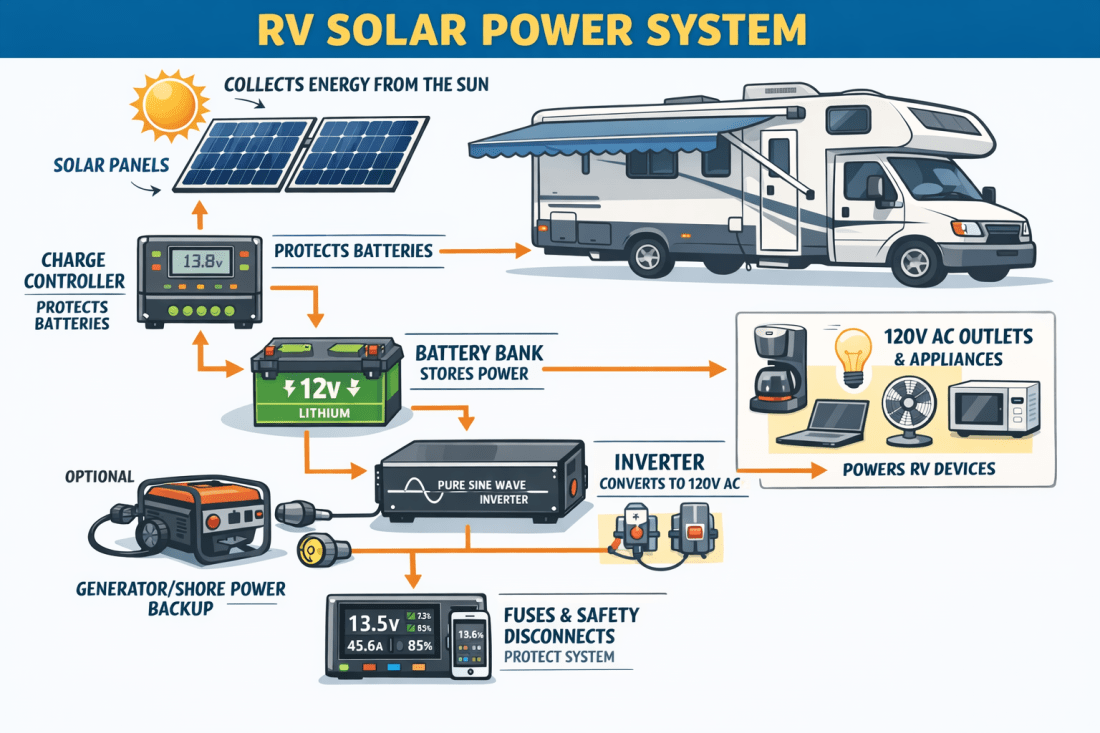
  5. That electricity is sent to a charge controller and batteries
  6. An inverter converts it into household AC power

In short:

Sunlight → Electricity → Stored power → Usable power

Solar panels produce power whenever there is light, not just direct sunshine — though output increases with stronger sunlight.


The Main Types of Solar Panels

There are three primary types of solar panels used today:

  1. Monocrystalline
  2. Polycrystalline
  3. Thin-Film (Flexible or Rigid)

Each type has its own strengths and weaknesses.


1. Monocrystalline Solar Panels

What They Are

Monocrystalline panels are made from a single, pure silicon crystal, which gives them their dark black appearance.

Pros

  • Highest efficiency (typically 18–23%)
  • Produce more power in less space
  • Perform better in low light and heat
  • Long lifespan (25+ years)
  • Best choice for limited roof space (RVs, vans)

Cons

  • Higher upfront cost
  • Rigid construction (not flexible)
  • Slightly heavier than some alternatives

Best For

  • RVs and vans
  • Off-grid systems with limited space
  • Users who want maximum output and longevity

2. Polycrystalline Solar Panels

What They Are

Polycrystalline panels are made from multiple silicon crystals melted together, giving them a blue, speckled appearance.

Pros

  • Lower cost than monocrystalline
  • Proven, reliable technology
  • Good performance in full sunlight

Cons

  • Lower efficiency (15–17%)
  • Requires more roof space
  • Slightly reduced performance in heat
  • Heavier for the same output

Best For

  • Larger roofs
  • Ground-mounted systems
  • Budget-conscious installations where space is not limited

3. Thin-Film Solar Panels (Flexible Panels)

What They Are

Thin-film panels are created by layering photovoltaic material onto a flexible surface. These panels are lightweight and can bend to fit curved surfaces.

Pros

  • Lightweight
  • Flexible mounting options
  • Low profile
  • Easy installation on curved RV roofs
  • Perform better in partial shading

Cons

  • Lowest efficiency (10–13%)
  • Shorter lifespan
  • Degrade faster over time
  • Require more surface area
  • Often cost more per watt long-term

Best For

  • Weight-sensitive RVs
  • Curved or irregular mounting surfaces
  • Temporary or supplemental solar setups

Rigid vs Flexible Panels: A Quick Comparison

FeatureRigid PanelsFlexible Panels
EfficiencyHigherLower
Lifespan20–30 years5–10 years
WeightHeavierVery light
DurabilityVery durableProne to damage
Cost per wattLower long-termHigher long-term

Which Solar Panel Type Is Best?

There is no “one-size-fits-all” solar panel.

  • Limited space? → Monocrystalline
  • Lowest cost per panel? → Polycrystalline
  • Weight or curved roof concerns? → Thin-film
  • Long-term investment? → Monocrystalline rigid panels

For most modern RV and off-grid systems, monocrystalline panels provide the best balance of efficiency, durability, and long-term value.


Final Thoughts

Solar panels are the foundation of any off-grid power system. Understanding how they work and the differences between panel types allows you to make smarter decisions, avoid costly mistakes, and build a system that matches your travel or lifestyle needs.

Whether you’re powering an RV, cabin, or off-grid home, the right solar panel choice can mean the difference between struggling for power and living comfortably off the sun.

Day 3050