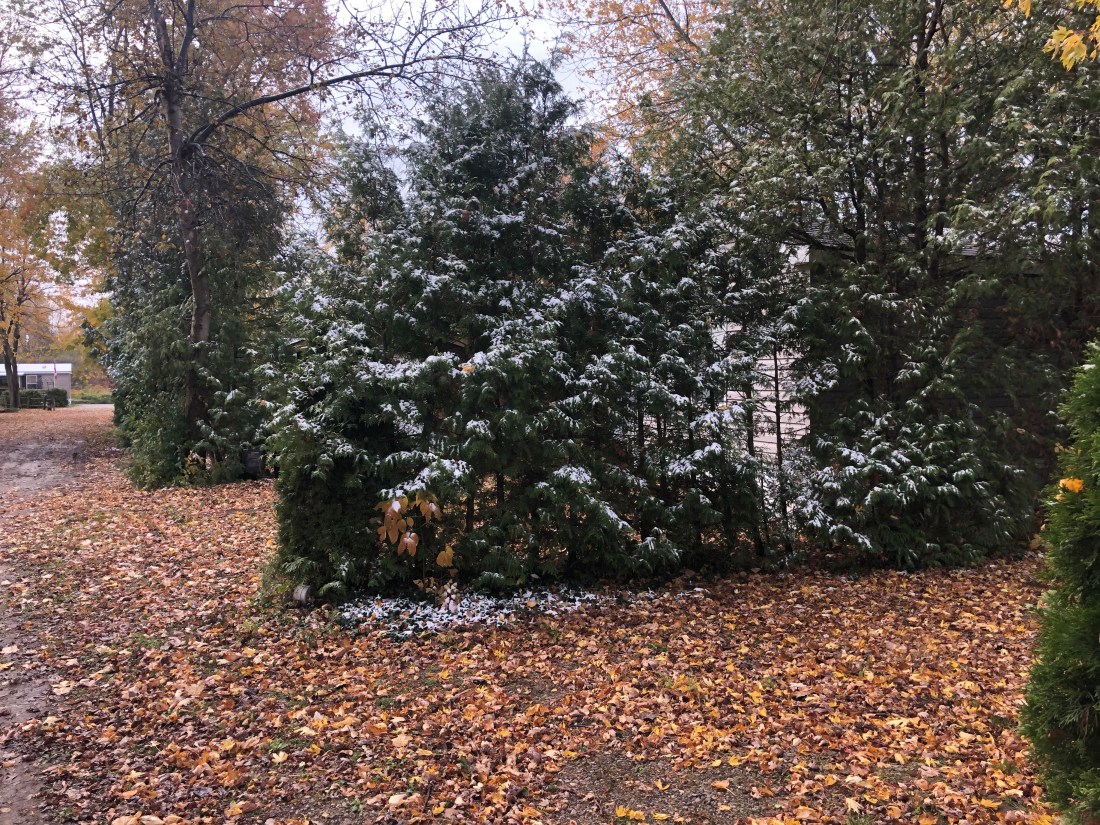
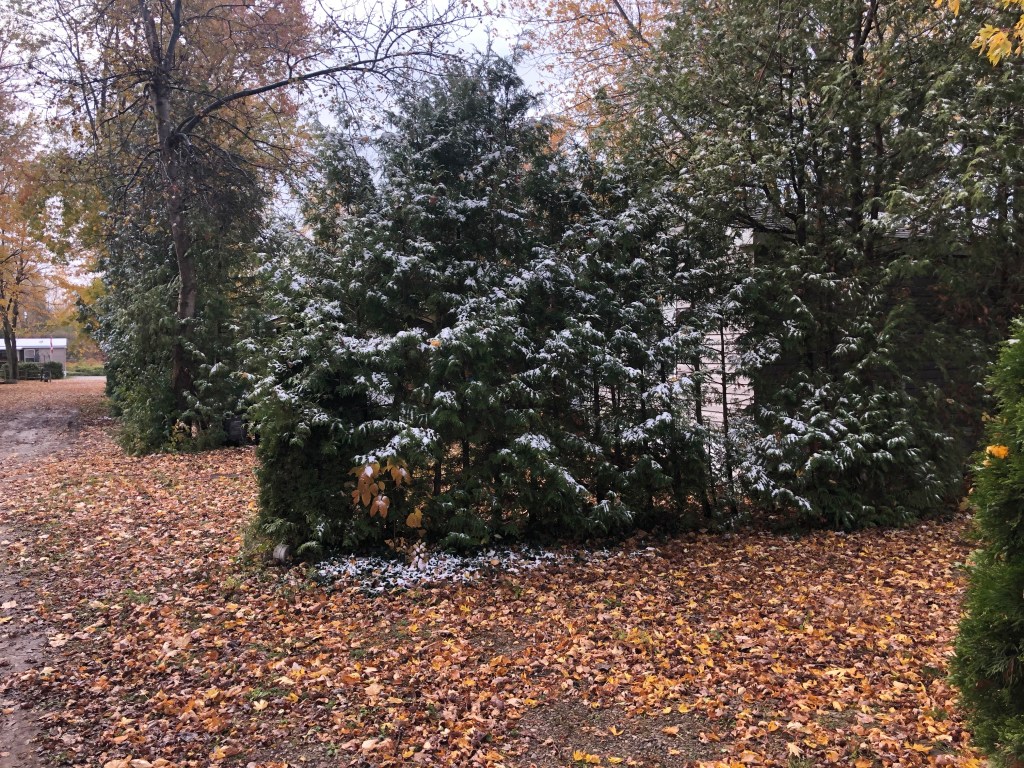
So we woke this morning to snow, now we are not new to snow, but we still don’t have to like it!
We are often asked why the park is not open later in the season, well this is why. This is also why there was a huge panic this year to get the park winterized, as the temperature dropped to 0ºC (32ºF) over night and here at 11 o’clock we have almost reached our high temperature of the day of 3ºC (37ºF) but with the breeze the wind chill will remain below freezing all day. So we closed the park on Tuesday at 5 pm and we were able to have everything protected from freezing at 10 am Thursday. It was kind of been like an endurance test this week, but one that we had to accomplish to evert any frozen water line nightmare …
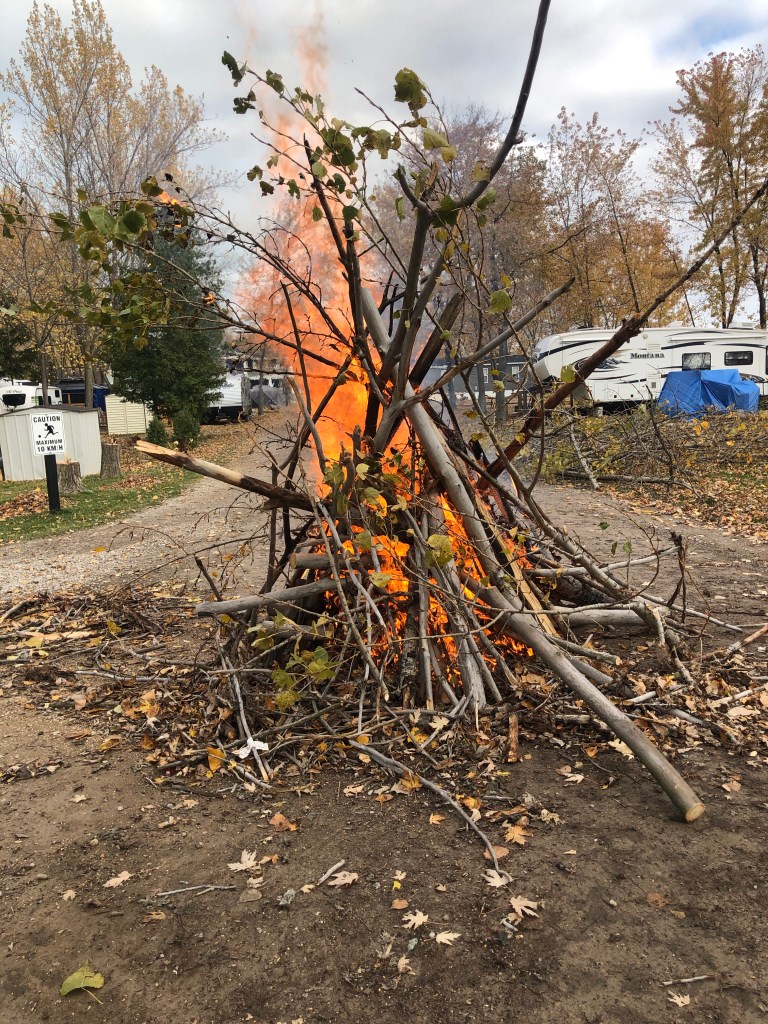
We now have started working on park projects, Thursday we cut down three large poplar trees, which is just a start, we have a long list of trees to trim or remove. We were able to take down these first three trees by our selves, making use of seasonally empty lots, we are able to drop the trees and then cut them up and remove the debris. Because these three trees today were all poplar trees which literally explode when we drop them to the ground and the clean up is time consuming and cleaning up the debris involves gathering and burning all the smaller branches.
We also have a spool of tech-cable strung between a pair of picnic tables to replace one of the older power lines in the park. The old power lines was loop feed which means the power line runs to the first breaker box then goes on to the next, and then on to the last breaker box. So each power line feeds a total of 10 thirty amp sites, protected by one large circuit breaker. The new system will have three separate power feeds to three no espérate breaker panels, each with its own smaller circuit breaker. One of The issues has been that more people have been using their trailers as summer homes as opposed to weekend getaways, and have added almost every appliance that they would have in your home … the difference is that most homes are operating on 100 or 200 amp services as opposed to 30 amp circuits so breakfast and dinner were becoming overload times which would see the main breaker being tripped for that whole row. Just because of all the extra appliances being used at once instead of using the propane equipment that the trailers were supplied with, or as we say glamping not camping …
Why? Why? Why? We have all asked the question, why do we turn the clocks back in the fall and ahead one hour in the spring? And depending where you lived the answer could have got could vary for a number of different reasons most of which were not really the true reason.
One example was what I learned as a kid … the time changed so that all the people that worked in offices and factories could enjoy more of the warm summer weather.
Now that was obvious was not the actual reason, it quite possibly could be an enjoyed side effect but is certainly not the reason.
I remember a local radio announcer saying it was done for the farmers, to give them more time to work in the fields … as if farmers ever really used clocks to decide when to go what to do, as most were up before sunrise and worked to sunset. No a calendar is more important time indicator to a farmer than most clocks.
So where did Daylight Savings Time come from? Any why?
George Hudson (a British born New Zealander) first proposed the idea of daylight saving in 1895. The German Empire and Austria-Hungary organized the first nationwide implementation starting on April 30, 1916. Many countries have used it at various times since then, particularly since the 1970 energy crisis DST (Daylight Savings Time) is generally not observed near the equator, where sunrise and sunset times do not vary enough to justify it. Some countries observe it only in some regions; for example, parts of Australia observe it, while other parts do not. Only a minority of the world’s population uses DST; Asia and Africa generally do not observe it.
DST clock shifts sometimes complicate timekeeping and can disrupt travel, billing, record keeping, medical devices, heavy equipment, and sleep patterns. Computer software often adjusts clocks automatically, but policy changes by various jurisdictions of DST dates and timings may be confusing.
Industrialized societies usually follow a clock-based schedule for daily activities that do not change throughout the course of the year. The time of day that individuals begin and end work or school, and the coordination of mass transit, for example, usually remain constant year-round. In contrast, an agricultural society’s daily routines for work and personal conduct are more likely governed by the length of daylight hours and by solar time, which change seasonally because of the Earth’s axial tilt. North and south of the tropics daylight lasts longer in summer and shorter in winter, with the effect becoming greater the further one moves away from the tropics.
By synchronously resetting all clocks in a region to one hour ahead of standard time, individuals who follow such a year-round schedule will wake an hour earlier than they would have otherwise; they will begin and complete daily work routines an hour earlier, and they will have available to them an extra hour of daylight after their workday activities. However, they will have one less hour of daylight at the start of each day, making the policy less practical during winter.
While the times of sunrise and sunset change at roughly equal rates as the seasons change, proponents of daylight saving time argue that most people prefer a greater increase in daylight hours after the typical “nine to five” workday. Supporters have also argued that DST decreases energy consumption by reducing the need for lighting and heating, but the actual effect on overall energy use is heavily disputed.
The manipulation of time at higher latitudes (for example Alaska) has little impact on daily life, because the length of day and night changes more extremely throughout the seasons (in comparison to other latitudes), and thus sunrise and sunset times are significantly out of phase with standard working hours regardless of manipulations of the clock. DST is also of little use for locations near the equator, because these regions see only a small variation in daylight in the course of the year. The effect also varies according to how far east or west the location is within its time zone, with locations farther east inside the time zone benefiting more from DST than locations farther west in the same time zone.
So Daylight Savings Time love it or hate it, is something we have been enduring for our lifetimes, gaining an hour, losing an hour, changing the clocks on all those electronic devices, at least our smart devices and computers automatically adjust the time.
I know as a traveler, time zones themselves add a special complexity when planning, I have often told about wintering in Quartzsite Arizona and playing golf in Blyth California only 20 kilometres away but was in a different time zone. Then add Daylight Savings Time and knowing that not every state (Arizona) or province will participate in DST, its even too much for my laptop to keep up with. At least my smartphone keeps up with the correct time in the areas we are traveling through … so I’m thinking the next great invention needs to be “Smart clocks”, we have atomic clocks that adjust themselves keep the correct time … I’m old enough to remember the VCR players and resetting those clocks … like seriously.