Have you ever been looking foreword to something so much, that when it happens, and doesn’t seem to live up to your expectations, it just leaves you wanting. That is kind of how we are feeling about this visit to Why, now don’t get me wrong, we are enjoying ourselves, but it just isn’t quite as we remember it. There is probably a few dozen reasons why, and as much our doing as not, part of it is the park as there have been many changes, some of which don’t make a lot of sense. But again it is a small village and if you don’t agree with the people in power, they can and will make your stay less comfortable, there seems to be a lot of power tripping going on. Many of the people we came to see are here and most are well, obviously age does take its toll, and as they say time waits for no man.
We are doing some maintenance on Thunder, I spent quite some time resealing our slide, there were a number of cracks in the chalking, so some new chalking and some spray sealant should resolve any leakage issues. There will be a steady stream of deliveries arriving over the next week or so as we have to gather items while we have a campground that will allow us to have items shipped. I ordered a number of items yesterday that should pretty much complete the power upgrade, I will add updates as it happens, some items will be temporary installed until repositioning can be done, hardware and required items are real scarce here and will be much easier to source in Quartzsite. Right now it’s just a waiting game and tracking all the different shipments.
Mmm mmm goodness
Enjoying some meals that are a little difficult to cook when boondocking, garlic shrimp Alfredo, shrimp from Rocky Point in Mexico, fresh roasted garlic, mmm mmm good, we also went to tasting the other evening, it’s kind of done like a pop up, here it’s a different chef each time and he prepares a few different items this one consisted of Mexican shrimp cocktail, Greek Spanakopita, and flan or raspberry crumble for desert, while each were tasty, I’m not sure it was good value, and each came in a different take away container, so there were just way too many little plastic boxes. They take your individual order so they could have just as easily put it on one plate or one large take away container. The amount of trash that was created was just stupid, they gave us compostable utensils, than had plastic boxes, and paper bowls, and afterwards it all just goes into a garbage bag…our America friends are not the best at recycling…just saying
Mexican shrimp cocktail
There is going to be a potluck on Friday for happy hour, we are looking forward to that, I think I will barbecue chicken drumsticks, as the local grocery store has them on for $0.49 a pound, they have some great bargains each week, but they have them as daily specials, so the meat is on special on Thursday and the produce is on special on Friday, just a wee bit of a pain. There is also a farmers market on Thursdays and Saturday that always used to have some nice items so we will be checking that out as well. I have been working at some maintenance but I haven’t been working too hard, that will change as more items arrive and time starts to run shorter….
Solar is a mystery to so many people, what, when, why, where, and how – there seem to be more questions than answers, and every dam fool has an opinion on everything – so this is just another opinion and it may or may not apply to you but take it for what it’s worth.
I think every one needs to understand solar! And to do so you need to have a basic understanding of batteries as that is an essential part of any solar system, even your solar operated walkway lights. I know I’m an opinionated old fart so here it goes. I have spent over 40 years in the automotive world, a licensed automotive technician, and really all I knew about batteries was the more cold cranking amps the better chance you had of starting your car on a frosty morning. We tested the specific gravity of batteries with a hydrometer to see if they were charged, we tested the battery strength by setting a specific load with a carbon pile, to check the voltage under load, rough voltage reading 12 volts it should start, 8 volts won’t start and 10 volts is a crap shoot. We recharge our car batteries with an alternator and if it provides between 13 and 14.5 volts it should charge the 12 volt battery more than 14.5 would boil the acid, and for most of my life that’s what I knew. The automotive manufacture would send out battery testing equipment that could check a batteries condition electronically, but we always felt it was more of warranty cost saving venture, as there was no real loading of the battery.
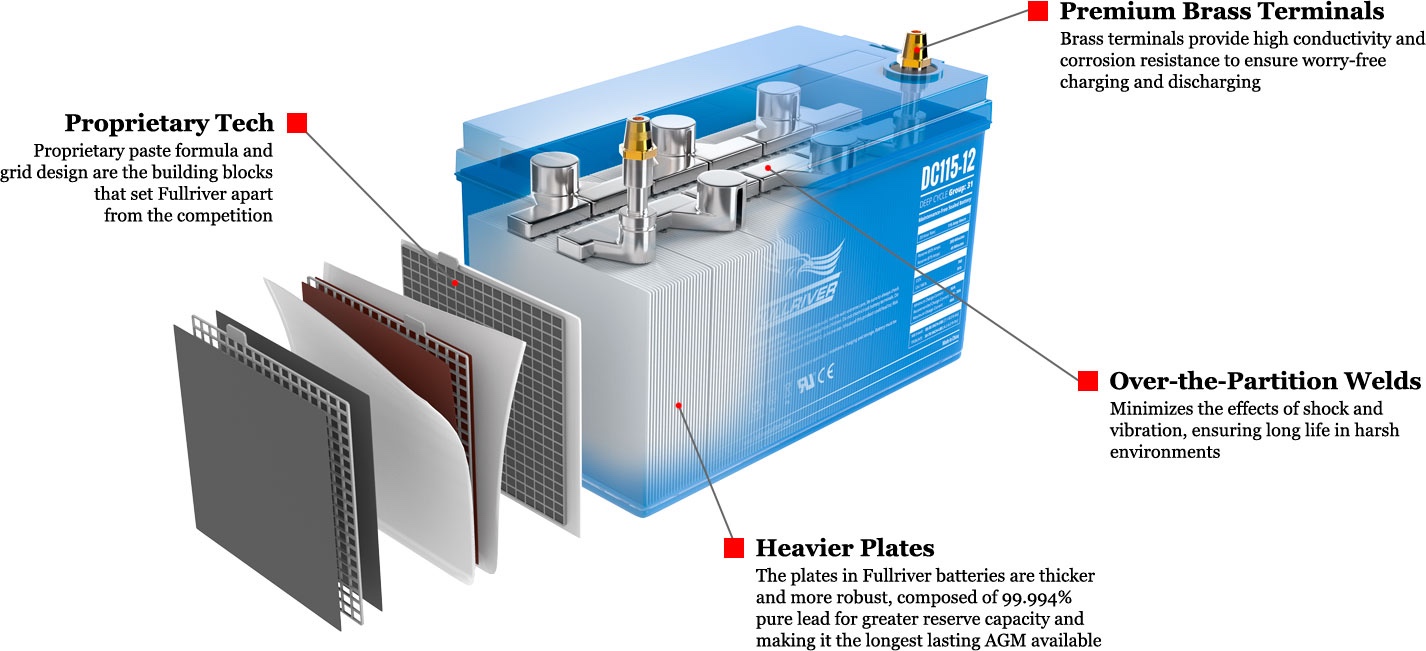
Typical AGM lead acid battery
Now I know a little more about batteries (notice I said a little), I now know my coach world my batteries are based on amp/hrs and the easiest way to get my head around that was if I had a light bulb that drew one amp and I had a battery with 100 amp/hr rating it should keep the light on for 100 hours, and I would be very wrong….at best it would keep the light on for 50 hours because if we draw the battery below 50% we are damaging it. I have hurt a lot of batteries in my day…just saying. The second thing I thought was if a 12 volt battery was at 50% it would be at 6 volts….wrong again….a 12 volt battery that is at 50% still has a voltage reading near 12 volts and a battery at 100% should read something over 12 volts like maybe 12.8 volts….shut the front door. This old dog needs help, so my 100 amp/hr battery only has 50 usable amp/hrs and if I use all 50 I am damaging the battery! I’m back to I have hurt a lot of batteries….wow. So in a perfect battery world I would only use 20 amp/hrs of the declared 100….WOW. And just to really confuse this old fart every battery manufacturer is different, yeh yeh I know they are different companies but what I did not know is that each battery manufacturer had specific charging rates…like they tell you what voltage to charge each stage at, and what battery voltage to move to the next stage…well in the automotive world it either charged or it didn’t. We all have battery chargers, every electronic item has it’s chargers who knew you should not mix them up because every battery needs different charging.
There are four stages of charging batteries:
Bulk
Acceptance
Float
Equalization
And every battery manufacture tells you how to do each stage and for how long. We are going to discuss the first three as the fourth is a whole new kettle of fish….so to speak.
BULK – high amperage with low voltage – this one is fun because the numbers are bigger, our battery bank is made up of 4 AGM 224 amp/hr 6 volt batteries so a total of 448 amp/hrs at 12 volts, of which 224 amp/hrs are usable, but in a perfect world I should only use 100 amp hours. See I finally got my one amp light to be lit for 100 hours and it only took four batteries…lol. So how fast can we charge our batteries, it depends on a lot of things but the quick answer is pretty darn fast and at big numbers, our batteries will charge at over 100 amps but only for a few minutes, why you might ask if it took 100 hrs of my one amp light to discharge my battery and I can charge them at 100 amps it should only take one hour right? Well No that’s not quite right if we took out one hundred amps it’s not that quick and simple, every battery has a resistance to giving and taking amperage, remember it is a chemical reaction that creates the amperage that has to be reversed to put it back, when you start your car you pull large amperage for a very short period of time, that’s why starting batteries are rated in cranking amps, our chassis batteries are 800 CCA (cold cranking amperage) each so we have up to 1600 amps to start the coach and the starter probably draws 600 amps for a few seconds so the battery is designed to release amperage quickly while the deep cycle type used for our battery bank releases amperage slowly which means it accepts amperage from the charge source slowly as well.
So we need to be very careful with our charger, ever wonder why there are expensive and cheap battery chargers that both say they are 50 amp chargers, well I didn’t until very recently. Then I find out that most of us are not charging our batteries fully or properly. Any coach that has a battery must have a way to charge it, so how are we doing that, a separate charger / converter hidden under some cabinet that charges the battery when hooked to shore power, or it could be part of the inverter / charger that we use when not connected to shore power, so when we plug into shore power it charges the batteries, or we may charge the batteries with our alternator when driving by using a rectifier to separate coach and chassis batteries and charge both, or with a solar controller if the coach is equipped.
I know now we have even more questions than when we started, well here is what 24 months have taught me, a battery monitoring system is a necessity, if you don’t know what condition your batteries are in how can you take proper care of them? The monitor will tell you if the batteries are at 85% or 80% and how many amp/hrs from fully charged they are, it also becomes your starting point as to the draw of every item on your coach, there are draws on the system at all times, the control board on our refrigerator draws a little more than one amp and it never quits, so 100 hrs and we are 100 amp/hrs down, and I am willing to bet that most of the batteries in most of the coaches have not been fully charged since they were installed if they were fully charged then. Our coach was almost 20 years old and did not have a monitor…I know now how the batteries are doing, what my draw loads are, even how many days since the batteries where fully charged. And being fully charged is hard to obtain, real hard, why so hard you ask because to takes hours of low amperage, high voltage charging to obtain and most chargers struggle to get there.
ACCEPTANCE – this is the charging stage that we are referring to low amperage, high voltage and seem to take forever! And after we have put every amp/hr back into the batteries we can say they are fully charged. Only now we can go to the third stage of charging.
FLOAT – this is some times called maintenance low amperage, low voltage to just keep it fully charged
EQUALIZATION – this is the “Hail Mary” of the charging world, used only after you have failed to keep you batteries fully charged. If lead acid batteries are not kept fully charged the lead plates sulphate this is part of the chemical reaction that discharges and recharges our batteries between the lead plates and the sulphuric acid, this is done with very high voltage and most chargers can not achieve this level and most battery manufacturers do not recommend this process, it does work, I have done it and are still using the batteries.
I know this is getting real long so the last subject for this part is on mixing batteries, do not do it. The battery bank is only as good as its weakest link, batteries have a life expectancy, the will only survive so many cycles, putting a new battery into the bank will help the bank but only to the level of the next weakest battery, just don’t do it!




 The Buchanan's Rolling Down The Road